
Introduction
Transformer oil insulates the windings and carries heat away from them. So when its chemistry, moisture content, temperature or volume shifts, the oil is often the first witness to a developing problem.
This guide is for US utilities, generating plants and industrial substations. It shows how to combine laboratory oil testing, online sensors, operating context and historical trends to decide whether oil condition is stable or needs investigation.
Key Takeaways
- Judge oil health from several indicators, never one reading.
- Rank DGA, moisture, temperature, level, pressure and oil quality by transformer criticality.
- Compare each reading with that unit's own baseline, load, ambient conditions and maintenance history.
- Treat an abnormal trend as a trigger to verify, not proof of a specific fault.
- Match the follow-up test or repair to the suspected mechanism.
Why Transformer Oil Health Monitoring Matters
Oil does four jobs: insulation, heat removal, arc quenching, and carrying dissolved gases from decomposing oil and paper. Aging oil and paper undermine every one of them.
- Water and oxygen reduce dielectric strength and deteriorate cellulose paper
- Moisture speeds paper depolymerization
- Sludge can deposit on windings and cooling surfaces and impair heat transfer
- Restricted oil ducts or pump faults can cause local overheating
The Gaps in Periodic Checks
Visual inspections, occasional samples, and protective-device operation all leave blind spots. A laboratory sample is a snapshot, and conditions can change between site visits. Online monitors add continuous data, but EPRI's evaluation found that different online DGA monitor technologies deliver varying accuracy.
Monitoring supports condition-based maintenance. It does not replace OEM instructions, qualified engineering review, laboratory confirmation, or site safety procedures.
Which Transformer Oil Indicators Should You Monitor?
Dissolved Gas Analysis (DGA)
Dissolved gases reveal thermal stress, partial discharge, arcing and cellulose involvement. ASTM D3612 covers extracting and measuring them by gas chromatography, including hydrogen, methane, ethane, carbon monoxide and carbon dioxide.
For mineral-oil transformers, the active interpretation guide is IEEE C57.104-2019. Ester-filled units need fluid-specific guidance, since mineral-oil criteria do not transfer.
No single gas diagnoses a fault. Composition, amount and rate of change are read together, and older Bureau of Reclamation guidance cautions against deciding from one DGA. Rising CO and CO2 trends point toward cellulose involvement, while hydrogen often accompanies electrical activity.

Moisture in Oil and Insulation
Water constantly moves between oil and paper, and oil's water solubility changes with temperature. A reading taken hot means something different from one taken cold.
Evaluate moisture alongside oil temperature, load and history. High moisture can lower dielectric strength, accelerate paper aging and contribute to bubble formation.
Estimating moisture in paper from moisture in oil relies on equilibrium assumptions that may not hold in aged units, so report the assumptions with the number. ASTM D1533 is the standard coulometric Karl Fischer method.
Oil Temperature, Load and Cooling Response
Top-oil temperature only means something in context. Compare it with load, ambient temperature, winding temperature and fan or pump status. IEEE C57.91-2025 covers loading of mineral-oil-immersed units.
Warning patterns:
- Higher temperature at comparable load and ambient
- Slow cooling after a cooling stage starts
- Temperature rise that doesn't track fan or pump operation
Dirty fan blades, blocked oil paths and pump faults are common cooling culprits.
Oil Level, Tank Pressure and External Leakage
Oil expands and contracts with temperature, so level and pressure move normally. A conservator with a bladder or diaphragm accommodates this while limiting air contact.
Unexplained decline or pressure change may mean leakage, gas generation, a blocked breathing path or a faulty instrument. Always cross-check with a physical walk-down.
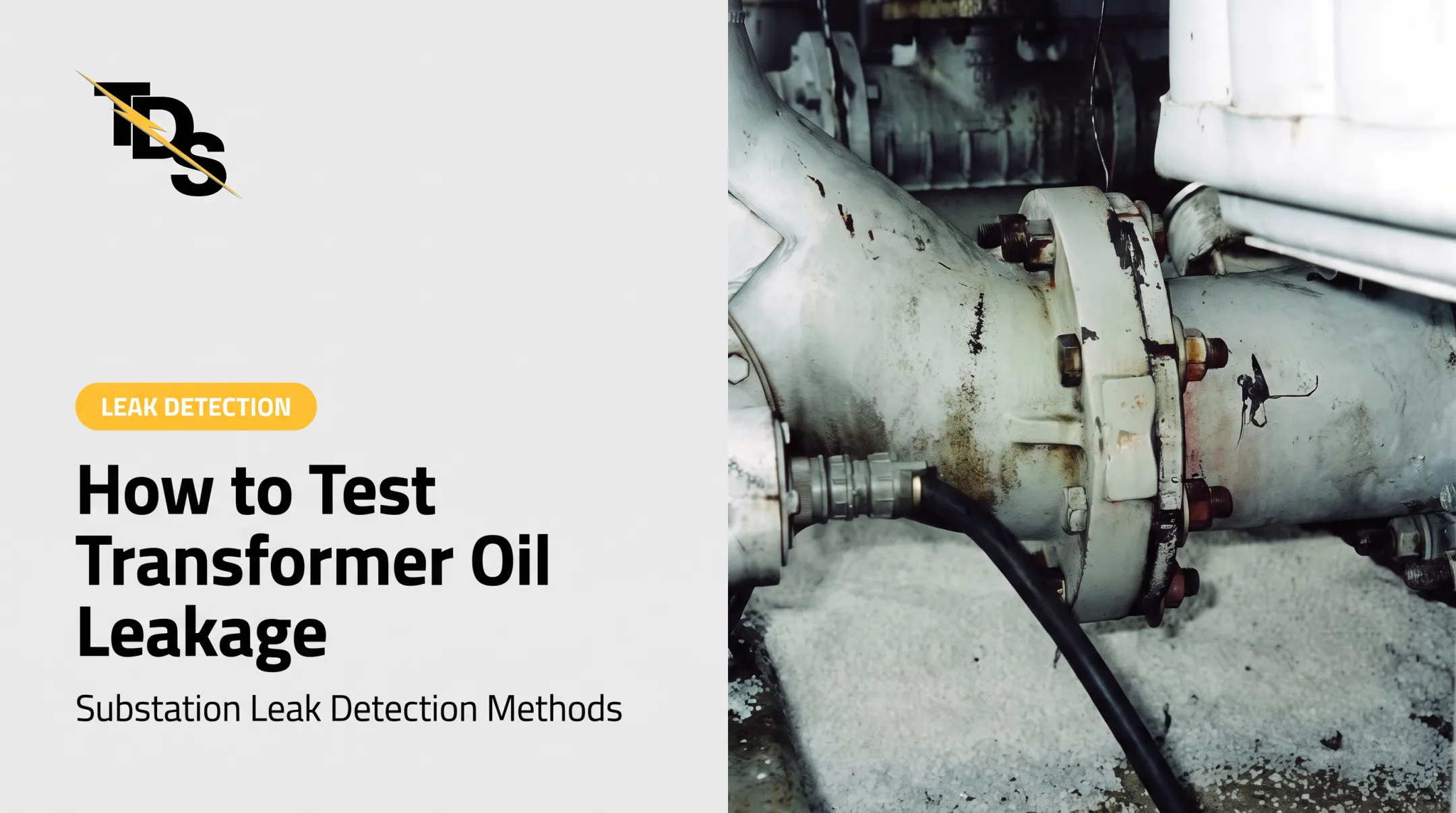
Visual checks alone often miss the exact leaking component. TDS cleans the suspect area and applies its Oil Leak Detector spray, which darkens at the leak.
Oil Quality, Fluid Type and Historical Condition
Laboratory properties complete the assessment:
- Dielectric breakdown (ASTM D877, D1816)
- Acidity (D974)
- Interfacial tension (D971)
- Resistivity and power factor (D1169, D924)
- Color (D1500) and sludge
Know the fluid. ASTM D3487 covers mineral oil, D6871 natural ester, and IEC 61099 synthetic ester. Results also need context: treatment, fluid replacement and sampling history all change how a number should be read.
How to Interpret Transformer Oil Health Data
Establish an Asset-Specific Baseline
Build normal ranges from commissioning records, earlier lab results, typical load, seasonal ambient swings, cooling stages and post-maintenance readings. Generic thresholds are a starting point only.
Review Trends and Rates of Change
Direction, persistence and rate often say more than one result. Track rising gas-generation rates, gradual moisture creep and worsening temperature response at consistent intervals. Consistent sampling per ASTM D923 keeps comparisons honest.

Correlate Independent Indicators
- DGA against temperature and load
- Moisture against oil temperature
- Oil level against pressure and visible leak evidence
Agreement raises confidence. Disagreement may point to sensor drift, sampling variation or an unrelated operating condition.
Validate Abnormal Results
Before changing loading, pulling a unit or authorizing repairs, confirm the data:
- Inspect the sensor and review calibration records
- Check sample handling
- Repeat the laboratory test
- Review operating events and protection operations
- Perform a physical inspection
Apply Standards and Owner-Defined Alert Levels
Check current editions before quoting limits. IEEE C57.106-2015 is listed Inactive-Reserved, and C57.91-2025 supersedes the 2011 edition. IEEE C57.143-2024 covers monitor application, not interpretation. NFPA 70B addresses preventive maintenance generally.
Owners should define warning, investigation and urgent-response levels per transformer, fluid and environment. No universal alarm value exists. One published example: a Reclamation manual recommends DGA after one month in service and annually, more often if problems appear. That is one operator's practice, not an industry rule.
From Monitoring Data to Maintenance Action
Triage by Severity and Asset Criticality
- Identify the affected indicator (which gas, moisture reading, or other parameter moved)
- Decide whether the change is sudden or gradual to set response urgency
- Weigh asset criticality and operating conditions against outage risk
- Verify the measurement before acting on a single reading
- Assign an owner and a response deadline so follow-up does not stall
Match the Follow-Up Test to the Suspected Mechanism
| Suspected issue | Follow-up |
|---|---|
| Gas generation | Confirmatory DGA and trend review |
| Oil degradation or moisture | Repeat moisture, IFT, acidity, dielectric tests |
| Hot spots, blocked cooling | Thermography, cooling inspection |
| Bushing insulation | Power-factor/capacitance testing, visual check |
| Internal discharge | Partial-discharge or acoustic testing |
| Winding or core movement | Sweep-frequency response analysis |
Respond to Confirmed External Oil Leaks
A confirmed external leak differs from internal oil degradation. Locate the leaking component, assess oil-level risk and follow site safety procedures. Facilities should also review spill obligations under EPA's 40 CFR Part 112, which depend on the facility and equipment.

For substation leaks, Transmission & Distribution Services offers low-pressure, cured-in-place gasket repairs that replace failed OEM gasket material. When conditions allow, these can avoid apparatus dismantling, and repairs are often done without removing equipment from service. TDS confirms the exact leak first and repairs only the leaking component. Leak-seal work carries a four-year warranty.
TDS does not perform DGA or replace engineering diagnostics. It seals the leak; it does not diagnose the oil condition.
Address Thermal and Cooling-Related Findings
Check fans, pumps, radiators, valves, controls, loading, ambient conditions and sensor accuracy first. Separate a cooling-system problem from an internal thermal fault before recommending load reductions or an outage. Thermography and gas trends help tell them apart.
Close the Monitoring Feedback Loop
Record what you confirmed and what you did next:
- Confirmed cause and corrective action
- Post-maintenance baseline
- Treatment or repair history
- Trend that follows the work
TDS's daily work logs, tied to the original survey and invoice, are one example of repair records that also support warranty tracking. Good records sharpen alarm tuning, scheduling, fleet prioritization and repair, refurbish or replace decisions.
Frequently Asked Questions
How do you monitor transformer oil health?
Track DGA, moisture, temperature, oil level, pressure and laboratory oil quality, then read them against load, baseline and history. Confirm abnormal results and get qualified review before acting.
What tests are used to assess transformer oil condition?
Common tests include DGA, moisture, dielectric strength, acidity and interfacial tension. The right set depends on fluid type, transformer design and criticality.
How often should transformer oil be tested?
It depends on OEM guidance, utility policy, age, criticality, prior results, operating stress and whether online monitoring is installed. Set intervals through an asset-specific maintenance program.
What does dissolved gas analysis reveal about transformer oil health?
DGA identifies gases tied to thermal and electrical stress. Gas patterns, generation rates and operating context must be interpreted together, with confirmatory testing.
What does rising moisture in transformer oil indicate?
A sustained, temperature-adjusted rise may signal ingress, insulation aging or preservation-system problems. Verify a single reading against temperature, load, sampling conditions and prior results.