
The answers drive outage planning, emissions, technician safety, equipment availability, gas costs, and how long the repair lasts. The stakes are real: EPA attributes approximately 67% of US SF6 emissions in 2022 to electric transmission and distribution, and the gas carries a 100-year warming potential of 25,200.
Recovery and online repair aren't rivals so much as tools for different failure modes. This guide shows how to tell which one your leak calls for.
Key Takeaways
- Recovery removes gas for access, testing, or disposal; it doesn't fix the leak.
- Online repair seals a confirmed, localized leak, sometimes without removing gas.
- Recovery fits when internal access or contaminated gas is involved.
- Online repair fits accessible leaks where an outage is costly.
- A combined plan is often the most practical answer.
SF6 Gas Recovery vs Online Leak Repair: Quick Comparison
| Factor | SF6 gas recovery | Online leak repair |
|---|---|---|
| Scope | Captures gas into approved recovery equipment; a separate repair may still be needed | Seals the confirmed leak at the gasket, joint, or fitting |
| Cost drivers | Recovery equipment or contractor, gas testing, storage, purification or replacement gas, labor, outage costs | Repair price weighed against avoided teardown, gas handling, and lost availability |
| Downtime | Typically tied to isolation, evacuation, and inspection | Can be shorter; some repairs happen in service when the site assessment allows |
| Compliance | Gas tracking, purity testing, storage, and records | Cuts continued gas loss, but detection and documentation still apply |
| Best fit | Internal access, contaminated gas, retirement | Accessible, localized defects |
Neither option is cheaper by default. Cost depends on the leak, the equipment, and what an outage costs you.
What Are SF6 Gas Recovery and Online Leak Repair?
What Is SF6 Gas Recovery?
Recovery is the controlled capture of gas from GIS, breakers, or other gas-filled apparatus into a recovery system instead of the atmosphere. It is not leak detection, repair, or reconditioning, though it feeds into them.
The workflow, at a high level:
- Make the equipment safe and de-energized.
- Connect compatible hoses and a gas cart.
- Remove gas to the required final vacuum.
- Test and filter the gas if it will be reused.
- Document quantity and condition.

The Bureau of Reclamation's FIST 3-16 guidance is specific: never de-gas a breaker while energized, and remove gas to below 0.29 psi (2 kPa), or the manufacturer's value, before accessing internal components. It also says not to vent SF6 manually unless no other option exists, and to analyze moisture, SO2, and purity.
Recovery fits these situations:
- Disassembly or major component replacement
- Internal inspection
- Decomposition-affected or contaminated gas
- Emergency intervention
- Decommissioning
- Repairs that can't be done with the compartment pressurized
Arc by-products and oxygen displacement make recovery a safety task, not just an environmental one.
What Is Online Leak Repair?
Online repair locates and seals a specific external leak without unnecessary gas evacuation or traditional teardown. Eligibility depends on leak location, pressure, accessibility, material compatibility, equipment condition, and safety controls.
The process, at a high level:
- Confirm the leak and identify the leaking component.
- Prepare the area.
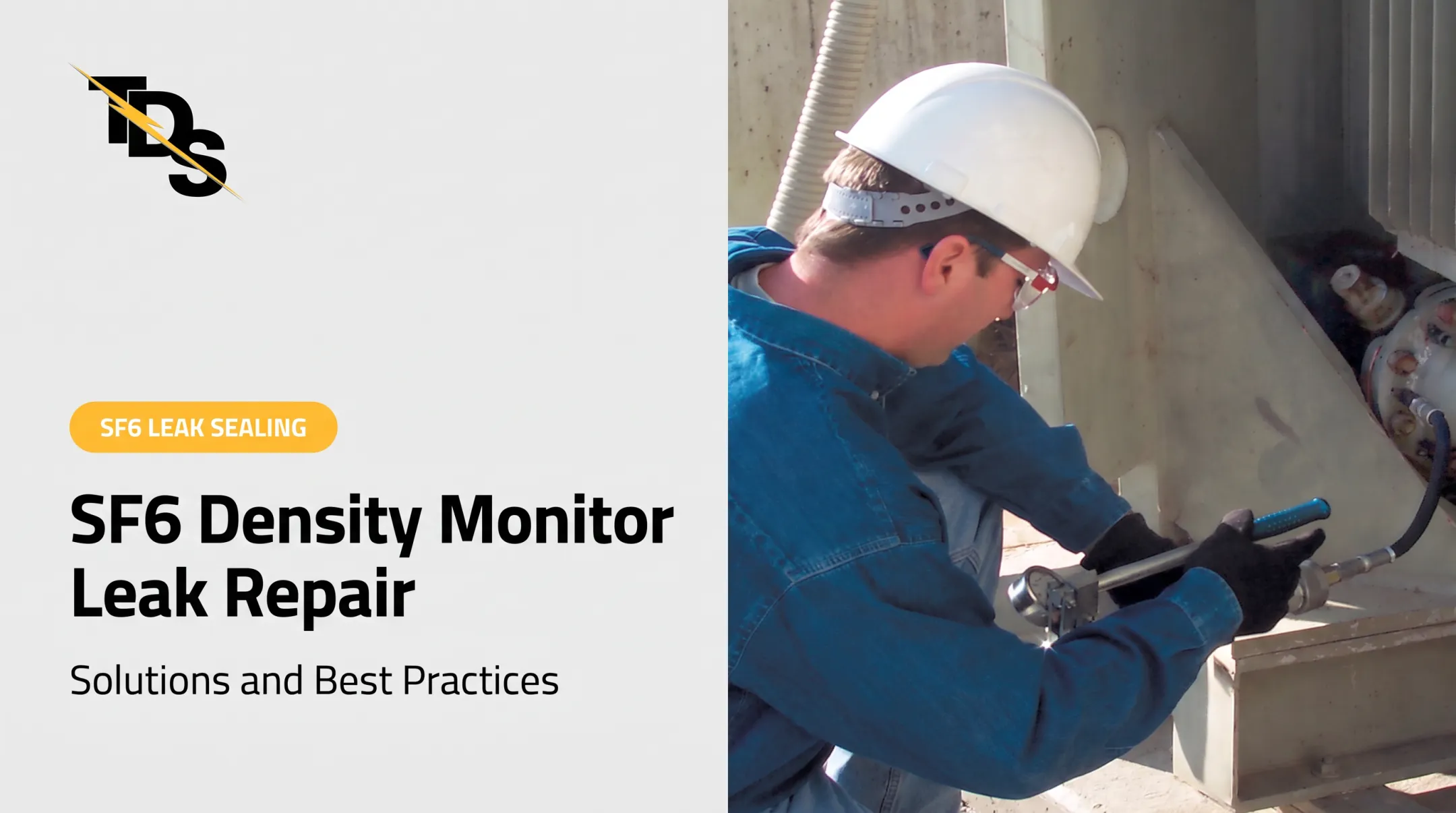
- Apply a compatible low-pressure sealing method (a clamp or enclosure with injected sealant, or a cured-in-place gasket).
- Let the sealant cure, then leak-test.
EPRI's 2013 technical update says sealing is often done while equipment is energized and pressurized because outages are hard to schedule. It also reports mixed results: some leaks can be sealed in operation and others can't.
Worker-safety rules still apply. OSHA 29 CFR 1910.269 requires qualified employees and minimum approach distances, and it can treat breaker housings as energized.
Transmission & Distribution Services (TDS) performs this work in the field. Its technicians work exclusively in substations and seal SF6 leaks on:
- Circuit breakers
- GIS piping
- Flange connections
- Seam welds
Repairs use custom clamps and a rubber-based sealant that cures in about 20 minutes at 70°F. TDS offers a free equipment survey and a four-year warranty. Site conditions determine whether a given leak qualifies.
SF6 Gas Recovery vs Online Leak Repair: Which Is Better?
Start with the failure mode, not the method. Ask what the priority is: access, eliminating a localized leak, gas quality, avoiding an outage, or replacing the asset.
Choose Recovery When
- The compartment must be opened
- The leak can't be isolated or reached externally
- The gas is contaminated
- Internal damage has occurred
- The asset is being retired or rebuilt
Choose Online Repair When
- The leak source is confirmed and accessible
- The surrounding equipment is structurally and electrically sound
- The method is compatible with the apparatus
- Preserving service is a primary goal
Detection comes first. TDS requires the exact leak source before proposing a method, using infrared laser scanning that shows the leak on video.
Consider a Combined Approach
Sometimes recovery is needed for a major repair, while a separate or recurring external leak could be sealed in place afterward. One documented plan can cover recovery, repair, testing, and refilling.
Site-Assessment Checklist
- Leak rate and location
- Gas pressure and quality
- Equipment age and condition
- Outage availability and the cost of going offline
- Manufacturer restrictions and warranty terms
- Technician qualifications
- Environmental records and reporting duties
- Expected life of the repair
Cost evidence is case-specific. A 2012 Alliant Energy presentation compared regasketing on a 69 kV breaker (5 days, $20,000) with a custom enclosure and sealant (1 day, $20,860). The prices were nearly equal; the time saved was not. It's one case, not a price schedule.

Real-World Examples and Case Studies
Alliant Energy: Regasketing vs. Enclosure
The Eddyville 69 kV breaker case, above, pitted a five-day regasketing job against a one-day custom enclosure with injected sealant. The repair was reported as tested successfully. Figures come from a vendor-associated presentation and should be read as case-reported results.
National Grid SA: Gas-Insulated Bus
EPRI reports a leak at a partial-discharge-sensor slot in a flange on a 380 kV gas-insulated bus. The repair needed no outage or pressure reduction. Monitoring afterward showed considerably less leakage and fewer annual refills, though EPRI gives no percentage. EPRI does not state whether the equipment was energized.
TDS: Westinghouse 2300 Bushing
TDS documented a leak between the porcelain and base mounting flange on a Westinghouse 2300 breaker. The fix was a two-piece aluminum clamp injected with rubber-based sealant. TDS says this repair takes about four hours without disassembly, versus a traditional route that leaves the breaker nonoperational. The case study does not include gas-recovery, labor, or repeat-leak results, so it reads as a technique description rather than performance evidence.

Takeaway
If you have a localized SF6 leak, a TDS survey can identify the equipment, leak location, repair method, and price before you commit to recovery, online sealing, or both.
Conclusion
Recovery is the responsible path when gas must come out for access, testing, major repair, or retirement. Online repair may fit better for a confirmed, accessible leak where in-service work and less disassembly matter.
The right call depends on equipment condition, leak location, gas quality, safety requirements, outage consequences, and your procedures. Don't pick by the lowest quote alone.
Frequently Asked Questions
What is replacing SF6 gas?
Vacuum, clean-air, and fluoronitrile- or fluoroketone-based technologies are emerging. Availability varies by voltage and design, and none removes the need to manage the installed SF6 fleet.
Can anyone buy sulfur hexafluoride?
Supplier controls, workplace safety rules, and environmental reporting can all apply. A nationwide purchase license is not clearly established in federal rules, so check current federal and state requirements and use qualified professionals.
Is SF6 gas recovery better than online leak repair?
Neither wins universally. Recovery is better when equipment must be opened or gas removed; online repair suits a localized leak where avoiding an outage matters.
Can an SF6 leak be repaired without recovering the gas?
Some accessible leaks can be sealed in place when the method, equipment condition, safety plan, and manufacturer requirements allow. Qualified technicians must confirm this.
When should SF6 gas be recovered before a repair?
Before opening a gas compartment, replacing internal components, handling contaminated gas, decommissioning, or doing work that can't safely be done under operating pressure. Follow the manufacturer's O&M instructions.