
That oil does two jobs. It insulates energized parts, and it helps extinguish the arc that forms when the contacts separate.
This guide ties the breaker's physical construction to what happens during a fault: detection, contact separation, arc control, and interruption. Once you see the parts as a system, the device stops being a black box.
Key Takeaways
- Insulating oil acts as both dielectric and arc-quenching medium.
- Core parts: contacts, oil-filled tank or arc chamber, bushings, operating mechanism, and arc-control features.
- The arc vaporizes nearby oil, and the resulting gas cools and de-ionizes the arc.
- Bulk-oil and minimum-oil designs differ in oil volume and insulation role.
- Oil condition, contact wear, leaks, and timing drive reliability.
What Is an Oil Circuit Breaker?
An oil circuit breaker is a mechanically operated high-voltage breaker whose separable contacts open in oil. NRC training material describes the contacts as immersed in oil, with interruption taking place in that oil. The oil cools and quenches the arc.
During a short circuit, the breaker must open the circuit without letting the arc persist and destroy equipment.
What an OCB is not
- It is not a manual isolator or disconnector.
- It is not a household low-voltage breaker.
- It does not decide when to trip. Protective relays detect the fault and send the command, while the breaker performs the interruption.
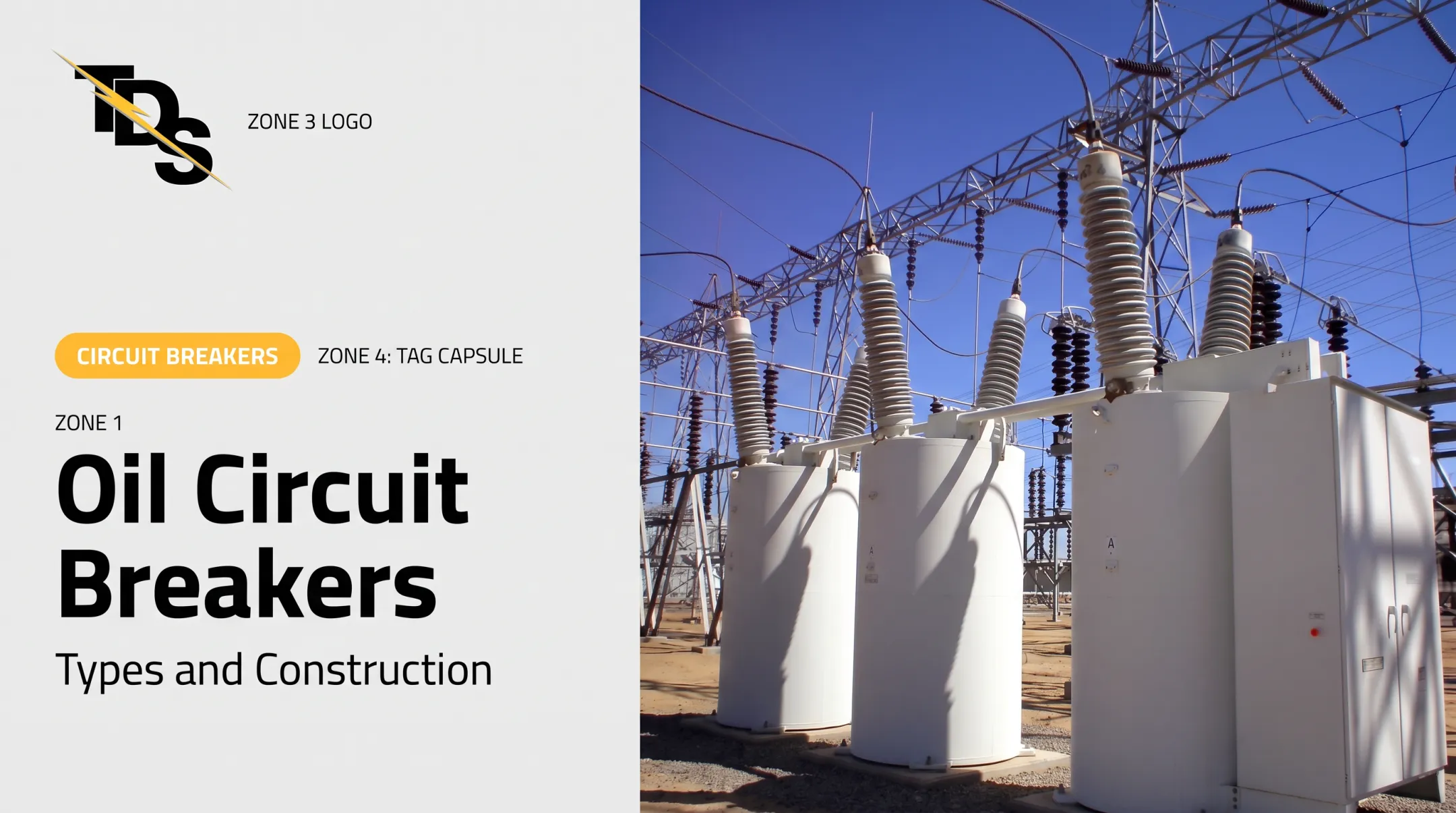
A typical example is a Westinghouse 345 kV oil-filled breaker: tall bushings, white tanks, overhead conductors, and steel supports.
Construction of an Oil Circuit Breaker
Main components
- Tank: Normally sealed and grounded. Small three-phase units may put all phases in one tank, while large high-voltage units use a separate tank per phase.
- Insulating oil: Insulates and quenches.
- Fixed and moving contacts: Immersed in the oil.
- Bushings: Porcelain bushings carry the connection through the tank wall.
- Operating rod and mechanism: Drives the moving contact. Actuators vary by model; some designs use a solenoid-operated mechanism.
- Terminals and control connections: Link the breaker to the circuit and to trip and close circuits.
Arc chambers and vents
Many designs surround the contacts with a rigid pressure chamber, often called an explosion pot. According to university power protection notes, confining the decomposition gas builds pressure that drives oil and gas through or around the arc.

Vent layouts, oil passages, and arc-control structures differ from model to model. Use the manufacturer's drawings rather than assuming one arrangement.
Types of Oil Circuit Breakers
Two separate classification schemes get mixed up often. One describes oil quantity, the other describes arc control.
| Scheme | Type | Distinction |
|---|---|---|
| Oil quantity | Bulk-oil | Large oil volume. Oil provides insulation to ground and arc extinction. |
| Oil quantity | Minimum-oil (live-tank) | Less oil, confined mostly to the interrupting chamber. Oil mainly quenches the arc. |
| Arc control | Plain-break | Arc control relies on contact gap. Used for lower breaking capacity. |
| Arc control | Self-blast | Arc-generated gas pressure drives oil across the arc. |
| Arc control | Forced-blast | A piston or similar mechanism generates oil flow independent of fault current. |
Some references cite an 11 kV limit for plain-break units, but that figure is not a universal rating. Confirm the exact design from the nameplate and manufacturer documentation.
How Does an Oil Circuit Breaker Work?
Operation is a coordinated sequence. A protection system identifies a fault, the trip mechanism separates the contacts, the oil controls the arc, and the interrupter restores insulation so the circuit stays open.
Initiation
Relays detect the abnormal condition and send a trip command. A trip coil energizes the operating mechanism, as the NRC electrical operation chapter explains. That signal is separate from the physical interruption inside the tank.
Stored mechanical energy then drives the moving contact away from the fixed contact. Opening speed, linkage condition, and contact travel all affect whether the breaker clears the fault.
Arc formation
Separation does not stop current instantly. Voltage ionizes the oil between the contacts, and an arc forms as they move apart.
Arc heat vaporizes and decomposes the surrounding oil. ABB reports a high-pressure bubble of "almost 80 percent hydrogen" that inhibits ionization, while oil and gas convection cools the arc residuals near current zero.
That figure is a reported mechanism, not a fixed composition for every operation.
Arc-control methods
- Plain-break: Relies on contact separation and arc length.
- Self-blast: Uses pressure generated by the arc itself.
- Forced-blast: Uses mechanically generated pressure or flow.
At low currents, self-blast pressure may be too weak, so some designs add a piston to promote oil flow. Explosion pots and arc-control chambers manage pressure and direct oil and gas around the arc. Exact vent and cross-jet geometry depends on the model.
Extinction and isolation
In an AC system, the arc extinguishes when current reaches a natural zero. The gap must then recover dielectric strength fast enough to withstand the transient recovery voltage. If it cannot, the arc restrikes.

The faulted section is isolated and downstream equipment is protected. The breaker returns to service only after qualified personnel verify its condition.
Where Are Oil Circuit Breakers Used?
Typical installations include utility substations, transmission and distribution switchyards, generating plants, and industrial high-voltage systems. Today many OCBs are legacy assets rather than the default choice for new work.
NRC training materials describe oil breakers as used mostly from 15 kV to 242 kV before SF6 designs took over due to maintenance cost and environmental concerns. Published voltage ranges are historical context; specific ratings belong to the nameplate.
A DOE record for the WAPA Archer Substation, for instance, describes replacing two 115-kV oil breakers with SF6 units in a 2020 proposal. That is one utility's decision, not a national rate.
What affects suitability
- Voltage and interrupting requirements
- Space, fire protection, and oil containment
- Operating duty and maintenance capability
- Manufacturer ratings
Newer installations may use vacuum or SF6 technology depending on the application.
Condition concerns
Watch for these common issues:
- Oil contamination or degradation
- Contact erosion and off-spec timing
- Insulation damage and external leaks
Oil testing, such as dissolved gas analysis, can flag overheating or excess arcing. Rising metals can point to contact problems, and water can point to seal or breather trouble.
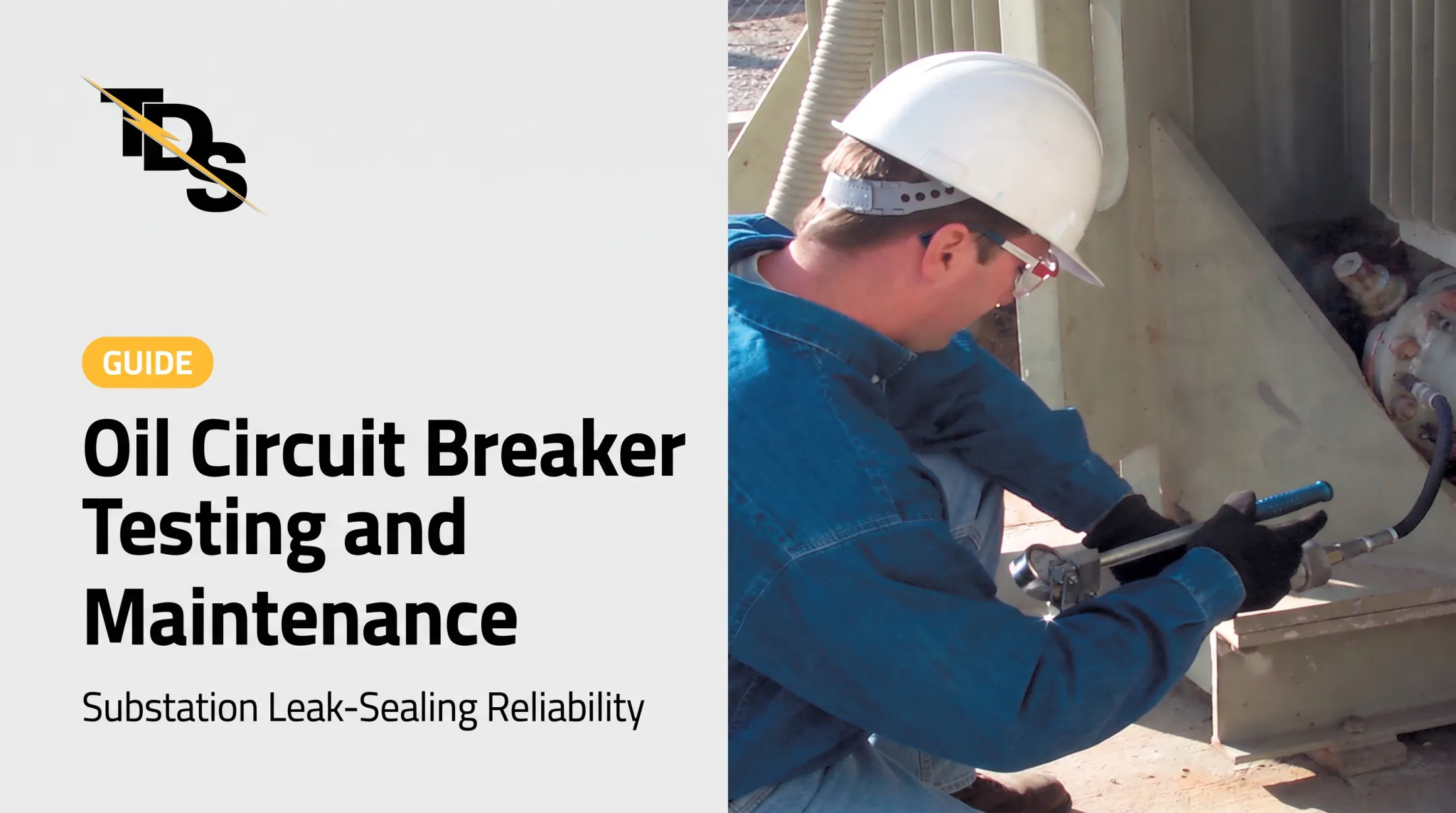
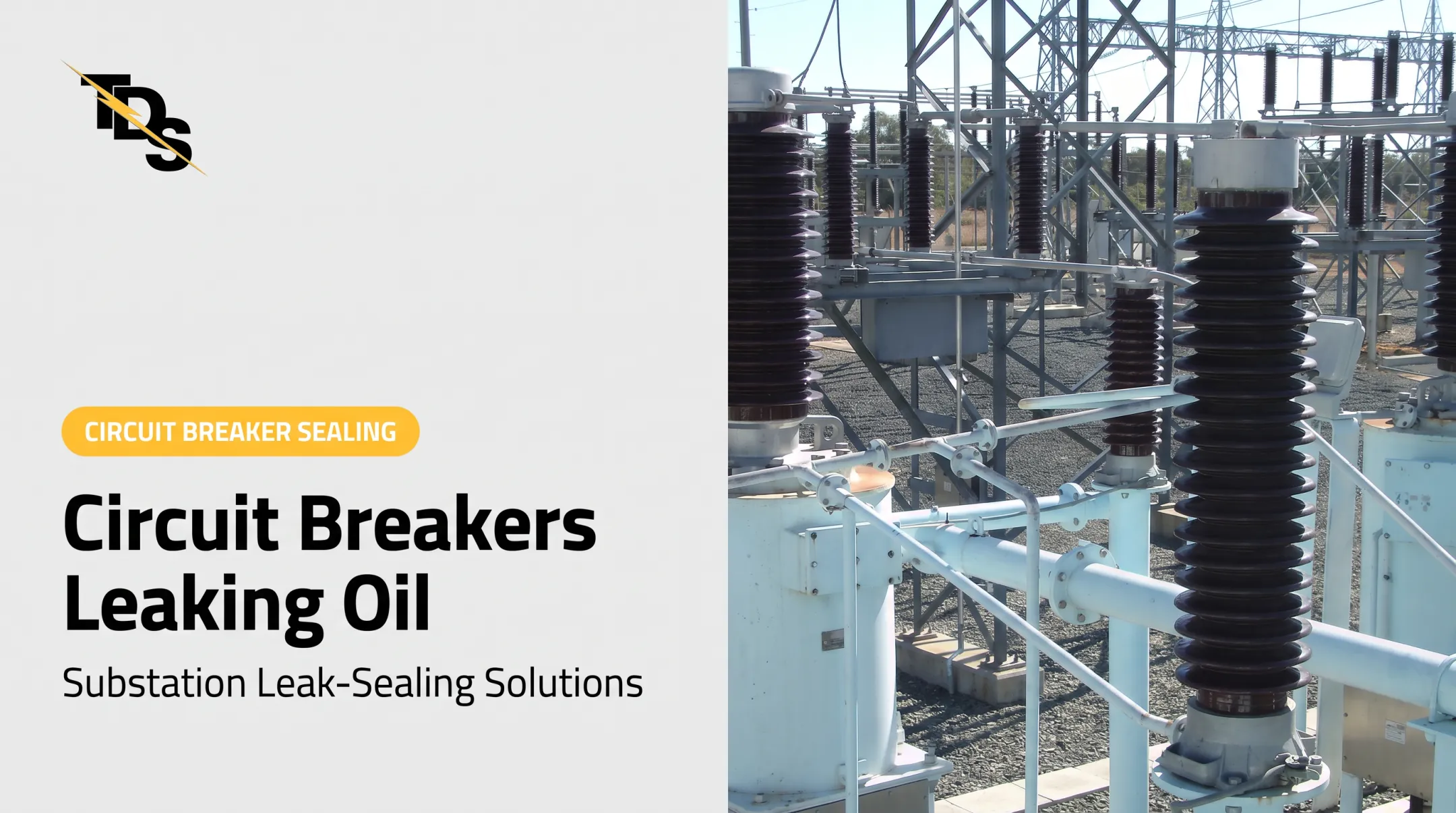
Leaks at bushing flanges, pipe flanges, and drain valves are common. Conventional repair means taking the breaker out of service and disassembling it.

TDS offers low-pressure leak sealing for oil-filled breakers using drill-and-inject procedures, custom enclosures, or clamps with rubber-based sealant. Where site conditions permit, repairs can be made without teardown, sometimes with the equipment energized. TDS also offers a free substation survey that documents each leak, the repair method, cost, and outage needs.
Conclusion
Oil circuit breakers interrupt current through a coordinated sequence. The mechanism separates the contacts, the arc turns nearby oil into a pressurized gas region, and cooling, de-ionization, controlled oil movement, and dielectric recovery clear the fault.
Knowing the construction makes maintenance decisions sharper. Evaluate design, oil condition, contacts, mechanism, leak condition, and manufacturer requirements together, as one system. That view also helps asset managers decide whether to refurbish or replace.
Frequently Asked Questions
What are oil circuit breakers?
They are high-voltage breakers that use insulating oil for dielectric insulation and to extinguish the arc formed when contacts open during a fault.
Where are oil circuit breakers used?
Mainly in substations, generating facilities, transmission and distribution systems, industrial high-voltage installations, and existing switchgear.
How does an oil circuit breaker extinguish an arc?
Contact separation draws an arc that vaporizes oil into a pressurized gas bubble. Cooling and de-ionization weaken the arc, and it clears at an AC current zero.
What are the main types of oil circuit breakers?
Bulk-oil units use large oil volumes for insulation and quenching. Minimum-oil units confine less oil to the interrupter. Arc control may be plain-break, self-blast, or forced-blast.
What are the disadvantages of oil circuit breakers?
The oil is flammable and can carbonize or become contaminated. Contacts wear, leaks raise environmental concerns, and qualified personnel must inspect and maintain the units.