
Introduction
A transformer bushing is the point where an energized conductor passes through a grounded steel tank. It's a small part, but it affects safety, uptime, and oil containment all at once.
A 2026 analysis of CIGRE survey data found that about one-quarter of the 848 major-failure records with location data were assigned to bushings. That is not a bushing failure rate, but it shows why the component deserves attention.
Maintenance teams usually ask the same things:
- What does a bushing do?
- How does it differ from an insulator?
- What types exist?
- Which signs point to deterioration or leakage?
This guide covers construction and function, testing, failure signs, and what to do when oil shows up around a bushing.
Key Takeaways
- A bushing is a sealed, insulated passage carrying current through a grounded tank.
- Design varies with voltage, insulation technology, housing, and environment.
- Evaluate inspection, electrical tests, thermal checks, and trends together against OEM data.
- Locate and assess any bushing-area leak before choosing between monitoring, sealing, or replacement.
What Is a Transformer Bushing and How Does It Work?
What a transformer bushing is
IEC defines a bushing as an assembly that lets one or more conductors pass through a partition, such as a tank, and insulates them from it. The flange or fixing device is part of the bushing.
Inside, the bushing connects the winding lead to an external cable, bus, or line connection. It keeps the conductor isolated from the grounded metal and keeps the tank boundary sealed.
How the bushing manages electrical stress
A bushing has two electrical roles: carry the rated current and control voltage stress between the live conductor and ground.
- Lower-voltage designs rely on bulk insulation around the conductor.
- Higher-voltage designs use condenser construction, with coaxial conductive screens that grade the field along the core instead of letting stress concentrate at one point, as ABB's technical article describes.
Mechanical, environmental, and reliability functions
The housing, flange, mounting hardware, and gasket support the conductor, resist mechanical loads, and keep moisture out and oil in. A failed flange gasket can start as a nuisance oil leak and end as a moisture path into the insulation.

Bushing condition matters for reliability, but bushings are only one possible failure source among windings, tap changers, and other components.
Transformer Bushing Construction and Types
Main parts of a transformer bushing
Typical components include:
- Central conductor
- Internal insulation or condenser core
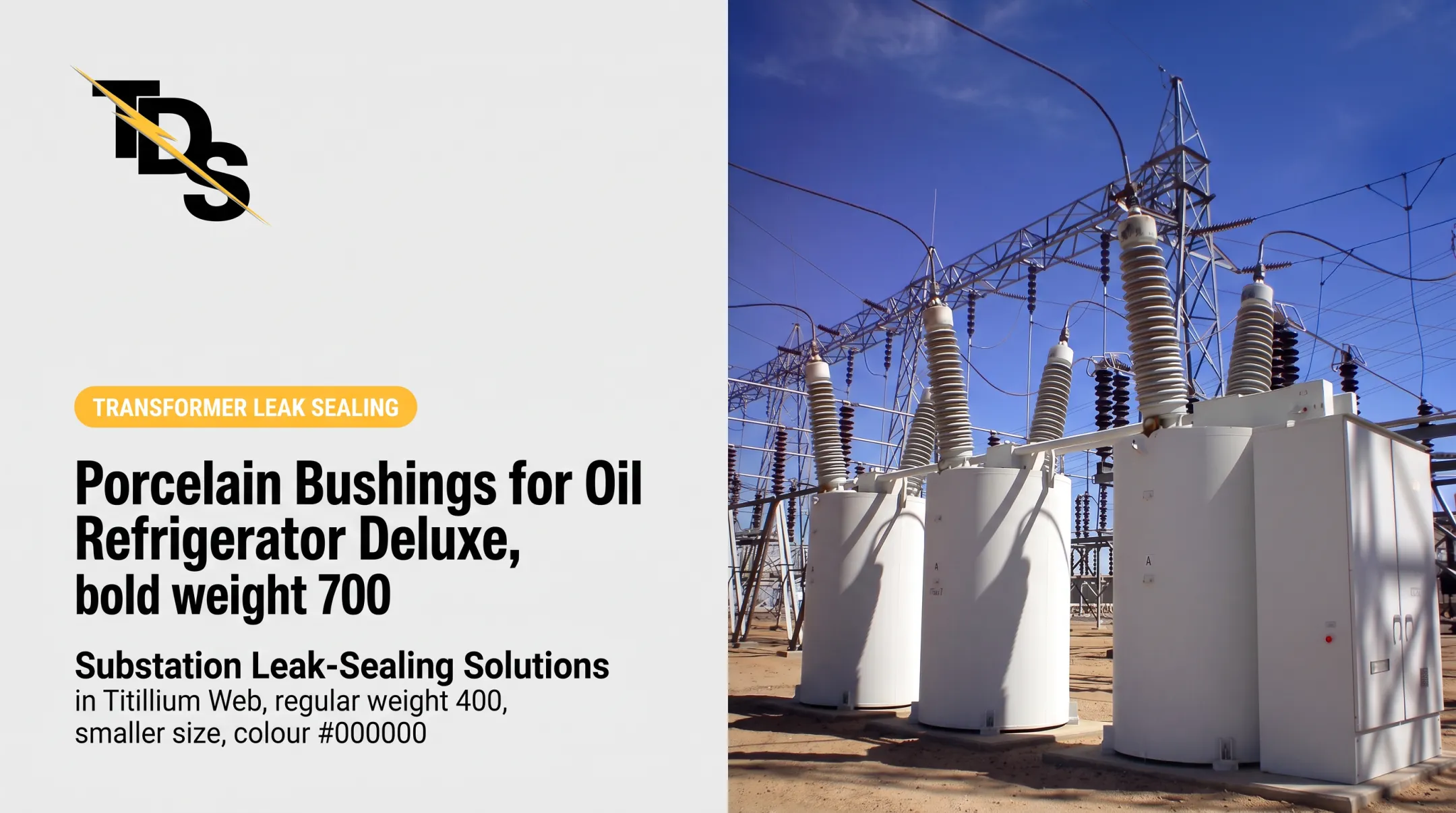
- Porcelain or composite outer housing
- Mounting flange and seals
- Terminal connections
- Test or voltage tap
Hitachi notes that almost all of its bushings include a capacitive test tap, though not every bushing does.
Sheds on the housing lengthen the surface path (creepage distance). That longer path limits surface leakage and flashover when outdoor contamination or moisture is present. Check required creepage and dry arcing distances against IEC 60137 and the OEM drawing.
Bulk versus condenser bushings
Bulk (non-condenser) bushings are simpler and have no graded field control. Condenser bushings add conductive layers for field grading, and their test taps support condition monitoring.
Voltage boundaries vary by manufacturer. Hitachi's DRY NC non-condenser line, for example, is listed at 24-52 kV, while its OIP condenser TOB line covers 72.5-170 kV. Treat these as product ranges, not universal cutoffs.
OIP, RIP, and RIS insulation
| Type | Construction |
|---|---|
| OIP | Kraft-paper core saturated with mineral oil, usually porcelain housing |
| RIP | Crepe-paper core impregnated with cured epoxy, dry construction |
| RIS | Synthetic fabric replaces paper; epoxy is the main insulation |
Hitachi describes RIS as non-hygroscopic, easier to store, and fire-resistant. Verify those claims in the product documentation when you compare oil leakage, moisture sensitivity, and partial-discharge performance.
Porcelain and composite housings
ABB describes composite silicone-shed housings as lightweight and non-brittle, and warns that shattered porcelain can throw damaging fragments. Hitachi claims high seismic resistance for its RIS design.
Choose housing based on location, contamination level, weather, seismic requirements, and available clearances.
Application and terminal configurations
Transformer bushings are typically air-to-oil. Air-to-gas and air-to-air configurations belong mainly to other apparatus, so confirm with the OEM.
Live-front and dead-front terminology comes from low-voltage liquid-immersed transformers. NEMA 8TP-PS1-2021 describes dead-front bushings as typically cast resin. The right configuration depends on ratings, connection method, enclosure, clearances, and utility requirements.
Transformer Bushings, Insulators, and BCTs
What is the difference between a transformer bushing and an insulator?
An insulator isolates and supports. A bushing is a specialized passage that carries a conductor through a grounded wall and includes mounting and sealing features. A post insulator is not a bushing unless it performs that tank-penetration function.
A bushing contains insulating elements, so simplified explanations sometimes call it an insulator. In engineering documents, the terms aren't interchangeable.
What is a BCT (Bushing Current Transformer)?
A BCT is a current transformer arranged around the bushing conductor. It measures current for metering, protection, or monitoring without interrupting the primary path. GE Vernova's slip-over example uses toroidal cores with secondary terminals.
Not every bushing has one. Confirm ratio, accuracy class, wiring, and protection function from the nameplate and drawings, and use IEEE C57.13-2016 for CT selection.
Related terminology
- Conductor: the main current path
- Test or voltage tap: a monitoring connection, not a current path
- BCT: a measurement device around the conductor
- Flange and gasket: the mounting and tank seal
When you review a bushing drawing, identify the tank wall, conductor, insulation, BCT, and terminal so each part stays distinct.
Transformer Bushing Inspection, Testing, and Failure Signs
Visual and mechanical inspection
Look for:
- Oil or compound leakage
- Cracked porcelain or deteriorated composite sheds
- Contamination, tracking, and corrosion
- Loose hardware and damaged terminals
- Signs of overheating
Follow your site's electrical safety program and the OEM instructions. Don't approach energized equipment outside your qualifications and clearances. OSHA 29 CFR 1910.269 covers work on power transformation installations.
Electrical condition tests
- Capacitance: detects changes in the insulation layers
- Power factor/dissipation factor: measures dielectric loss
- Insulation resistance: checks overall insulation integrity
- Partial discharge: identifies internal discharge activity
Test selection depends on bushing design and system voltage. Compare readings with nameplate values, commissioning data, prior trends, manufacturer limits, and IEEE or IEC guidance. No single universal threshold applies. Hitachi cautions that the test tap must be dry for a correct dissipation-factor result.
Test taps, online monitoring, and thermal checks
A condenser bushing's tap supports condition assessment when you follow the correct procedure and grounding. Infrared thermography, online monitoring, and phase-to-phase comparison add useful context. The USBR FIST manual treats a markedly hotter phase as a likely bad connection. None of these methods replaces a full assessment.

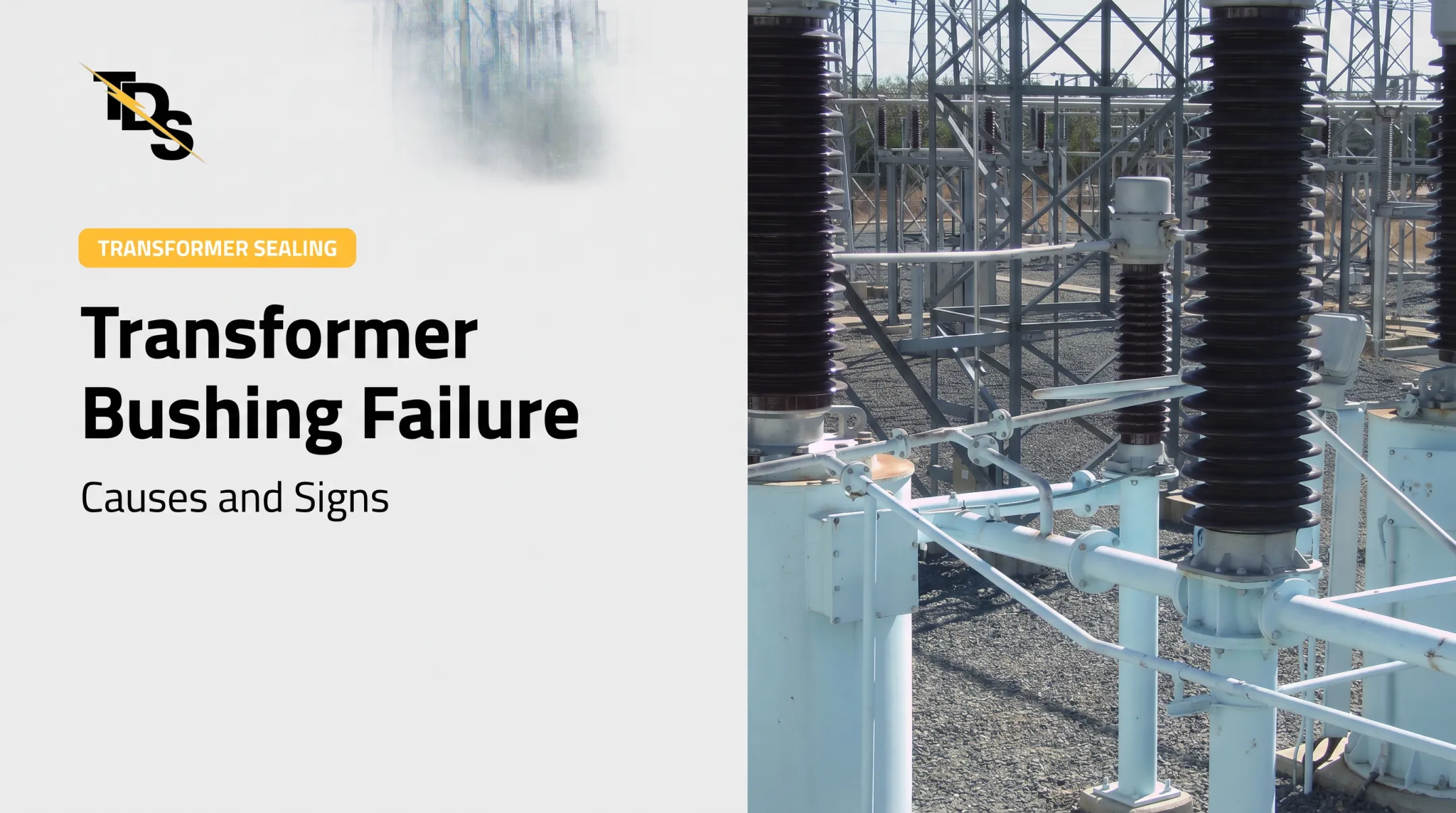
Common warning signs
- Visible: unexplained oil loss, cracks, chips
- Thermal: abnormal heating
- Acoustic: unusual noise
- Electrical: rising dielectric loss, changing capacitance, partial discharge
- Environmental: moisture entry, contamination
Cracks through the insulator or large chips that reduce flashover distance call for escalation. Ambiguous trends call for further diagnostics or a planned outage evaluation.
Maintenance and replacement decisions
Age, loading, temperature cycling, contamination, moisture, test trends, damage, and obsolescence all feed the repair, monitor, or replace decision.
The USBR FIST manual says a bushing with low oil and a correctly compressed gasket should be replaced, and that a suspected lower-seal leak into the tank isn't field-repairable. That is one manual's guidance, so confirm current criteria with the OEM, IEEE C57.19.00 and C57.19.100, IEC 60137, and a qualified specialist.
What to Do When a Transformer Bushing Area Is Leaking
Confirm the leak location before choosing a remedy
Oil near a bushing doesn't prove the internal dielectric system has failed. The source may be a gasket, flange, terminal, valve, weld, or nearby component. Visual observation alone is often unreliable. Cleaning the area and applying a leak detector spray, which darkens on contact with oil, can pinpoint the source.
Document:
- Apparatus type and fluid
- Exact leak point
- Operating condition and temperature
- Visible damage
- Recent test results
Prioritize safety and equipment condition
Control the area, follow isolation and electrical-safety procedures, and prevent environmental release. Use qualified personnel for any energized assessment. Under 40 CFR Part 112, facilities with oil may have spill-prevention obligations, so involve your environmental group.
Internal electrical deterioration, severe cracking, fire risk, active gas release, or a compromised pressure boundary may call for removal from service or replacement rather than an external seal.
When specialized low-pressure leak sealing may be relevant
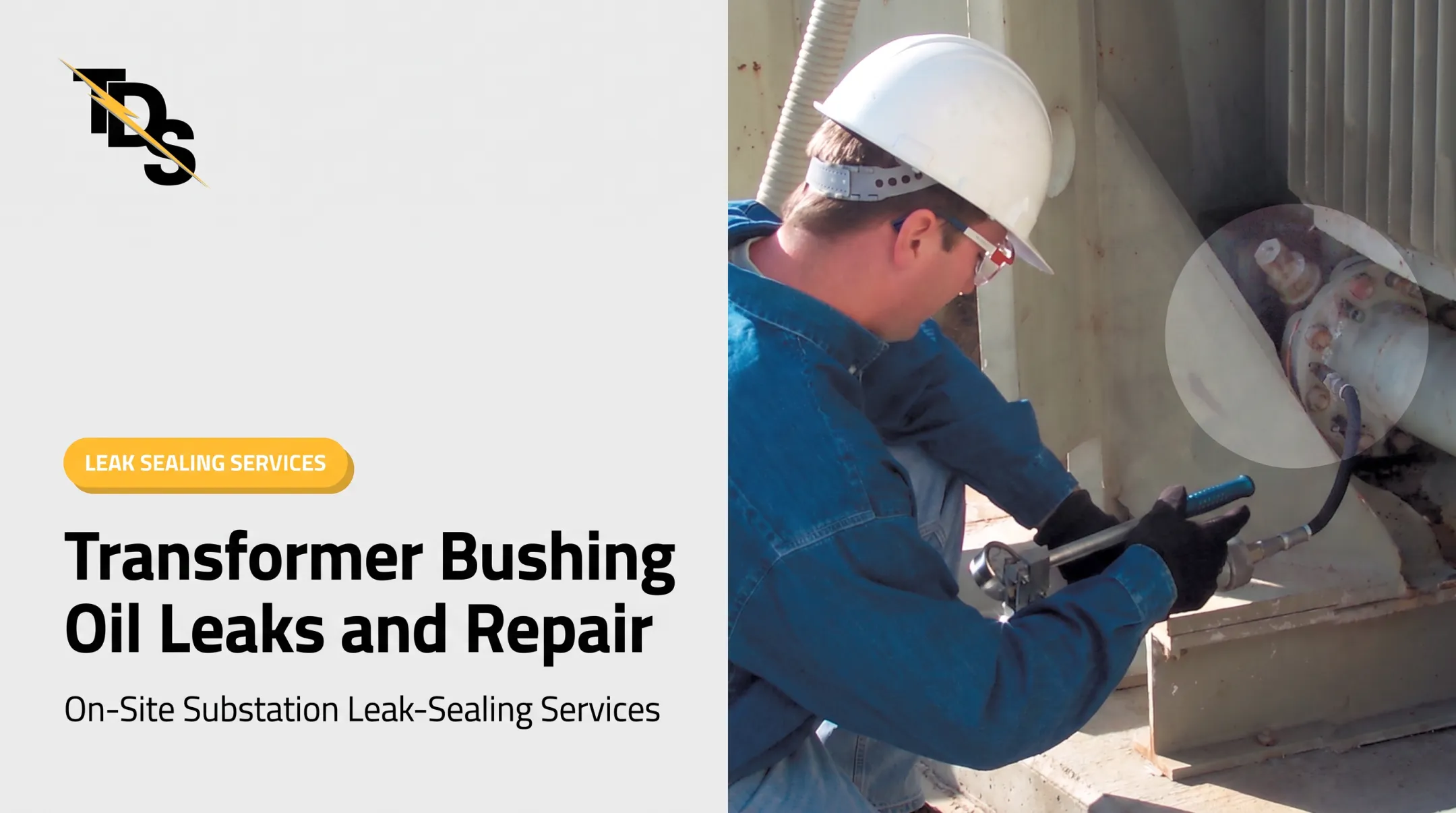
Transmission & Distribution Services (TDS) is a substation-focused provider of low-pressure leak sealing for compatible oil-filled and SF6-filled apparatus, including transformers. Bushing flange leaks are typically caused by gaskets reaching end of life, defective material, or poor installation.
TDS's approach:
- A free equipment survey identifies the equipment, leak location, repair method, and price before work begins.
- Technicians drill the flange gasket and inject sealant. If sealant can't travel the groove, they design a clamp around the split line.
- The cured-in-place gasket replaces OEM gasket material, and when conditions allow, equipment can stay in service.
Leaks near high-side, low-side, and neutral bushings may require the transformer to be de-energized and grounded.
TDS's sealant is oil- and SF6-compatible, its technicians are OSHA certified, and it states a four-year leak-seal warranty. Confirm suitability, scope, and warranty terms for your specific apparatus.

Frequently Asked Questions
What does a transformer bushing do?
It carries a conductor through the grounded transformer tank while insulating it from the enclosure and helping maintain the tank seal.
What is the difference between a transformer bushing and an insulator?
An insulator isolates and supports. A bushing adds the pass-through function: it carries a conductor through a grounded wall with mounting and sealing features.
What is a BCT in a transformer bushing?
A bushing current transformer is a CT placed around or near the bushing conductor for metering, protection, or monitoring.
What are the warning signs of a failing transformer bushing?
Oil leakage, cracks, abnormal heat, unusual noise, and changing capacitance or dissipation-factor results. Any of these warrants qualified evaluation.
How are transformer bushings tested and maintained?
Through visual inspection, thermography, capacitance and power-factor testing, and online monitoring where installed. Trend results against OEM and industry guidance.
Can a leaking transformer bushing be repaired without replacing it?
Some external gasket or flange leaks suit specialized sealing. Internal dielectric failure, severe damage, or unsafe conditions may require an outage or replacement.