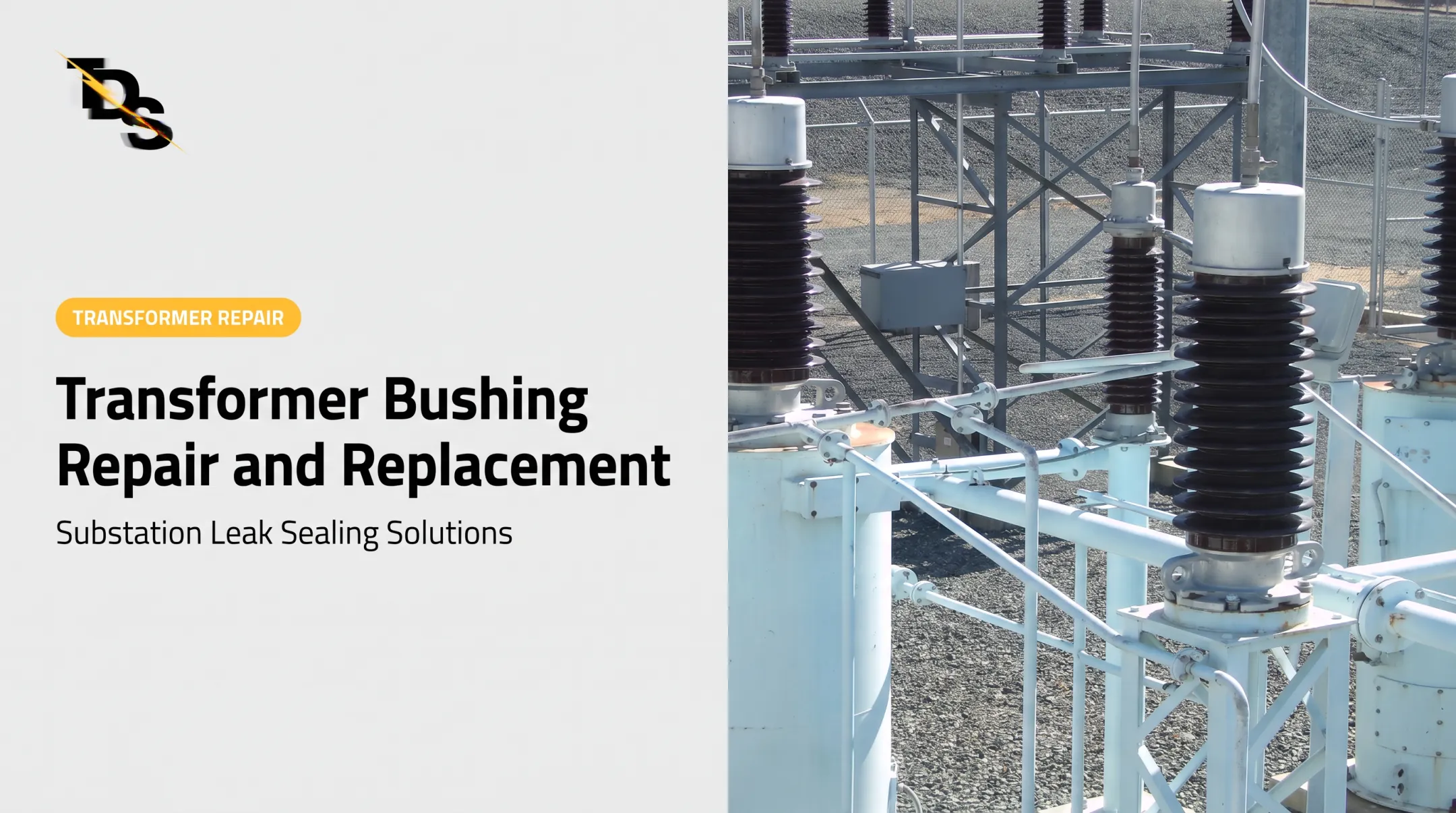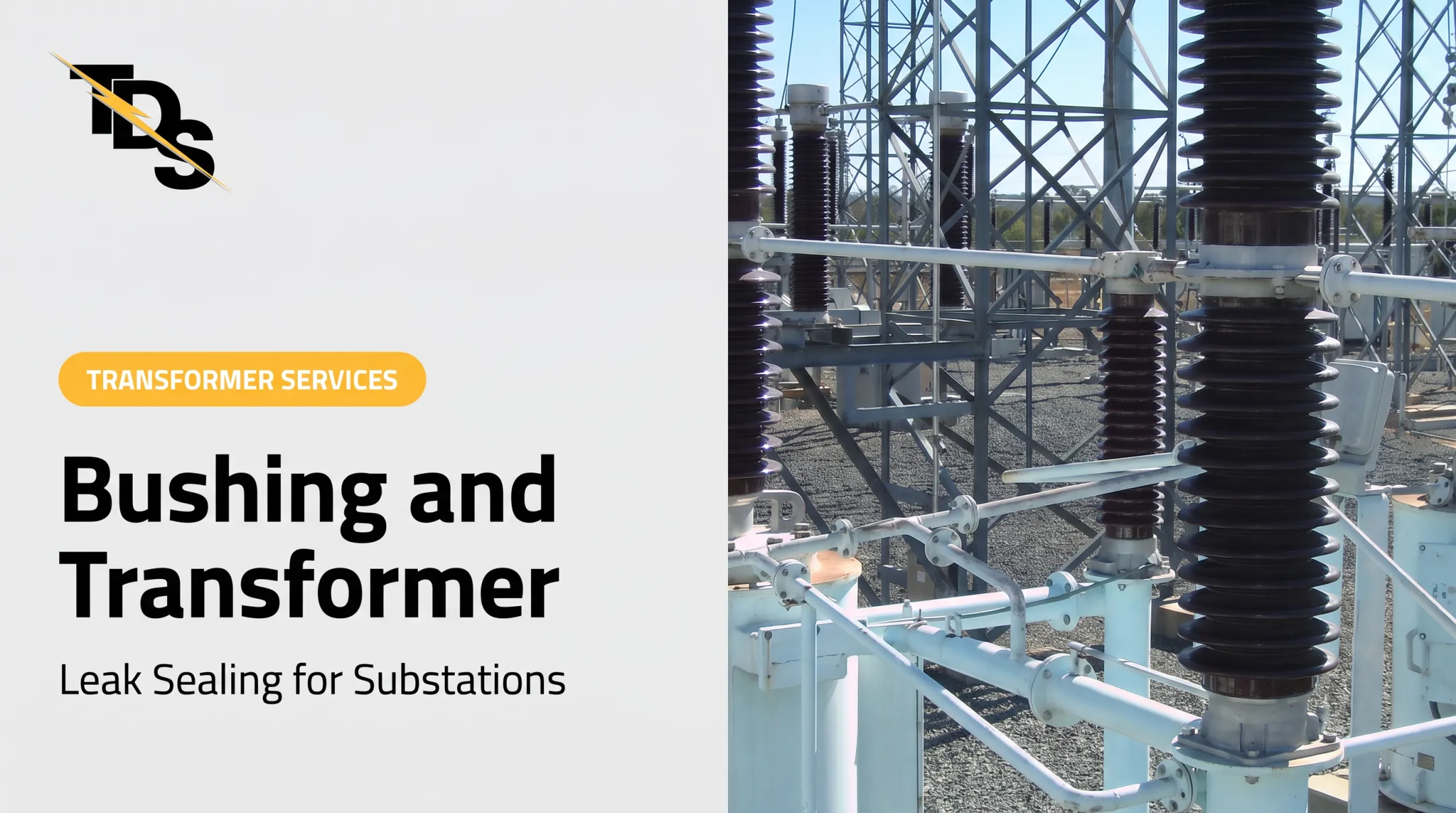

When it fails, the consequences go well beyond the bushing. CIGRE Working Group A2.43 cites utility failure data putting bushings at 5% to 50% of transformer failures, averaging about one-quarter, and calls them the most common cause of transformer fires.
Maintenance teams face oil leaks, moisture ingress, cracked porcelain, flashover, forced outages, and spill cleanup. This guide covers construction, selection, inspection, and leak response, plus when composite or epoxy designs deserve a look.
Key Takeaways
- An oil-filled porcelain bushing is a conductor, porcelain, internal insulation, fittings, and seals working as one assembly.
- Voltage, current, pollution, mechanical load, and mounting orientation all drive selection.
- Leaks often start at a gasket or flange, not the porcelain, so confirm the source first.
- No universal bushing dimensions exist; match replacements to the transformer drawings.
What Are Porcelain Bushings for Oil?
A transformer bushing's purpose
A bushing is an insulated passage that carries a high-voltage conductor through a grounded tank, enclosure, or other barrier. IEEE C57.12.200-2022 describes its main role as conducting current at high voltage through that grounded barrier. That passage is what separates it from an ordinary support insulator.
It performs four jobs at once:
- Carries current
- Maintains dielectric isolation
- Supports the conductor mechanically
- Helps contain oil
Porcelain housing and oil-filled construction
Glazed electrical porcelain forms the external insulating and structural housing. Depending on the design, oil surrounds the conductor or impregnates an internal insulation system.
Don't confuse an oil-filled bushing with a porcelain bushing sitting on an oil-filled transformer. The bushing's oil may be shared with the main tank or sealed separately, depending on the manufacturer's design.
Main design categories
Oil-filled porcelain bushings typically fall into two design families:
- Non-condenser (solid): a copper conductor inside a porcelain shell, with oil enhancing insulation (as in one Hitachi design)
- Condenser: paper and metal foils wound around the conductor so series capacitances grade the electric field
Don't assume one voltage cutoff separates the two. Check current manufacturer data and standards such as IEC 60137 or IEEE C57.19.00 and C57.19.01.
How Oil-Filled Porcelain Bushings Work
The electrical and insulating path
Current flows from the winding lead through the bushing conductor to the external terminal. Porcelain and internal insulation keep it from reaching the grounded tank.
In oil-paper designs, the condenser core is saturated with transformer-grade mineral oil. Degraded or contaminated oil weakens that insulation.
Glaze, sheds, and creepage
The glaze gives a smooth outer surface. The sheds lengthen the path leakage current must travel, adding the creepage and strike distance Hubbell describes. Rain, fog, salt, dust, and industrial deposits all test that design.
For numeric creepage guidance, use IEC TS 60815-1 and -2, which cover site pollution severity and insulator dimensioning.
Seals, flanges, and thermal movement
Gaskets, caps, and flanges hold the oil barrier while porcelain, metal, and oil expand at different rates. In Hubbell's PCORE design, cork-nitrile gaskets seal the assembly and coil springs keep compression steady through temperature swings.

Seals fail in predictable ways:
- Wrong bolt torque
- Damaged sealing surfaces
- Unsuitable gasket material
- Misalignment
- Installation at an unapproved angle
TDS field experience confirms the same pattern. Bushing-flange gaskets reach end of life, or fail early from defective material or poor installation workmanship.
Common failure mechanisms
IEEE C57.12.200-2022 names water ingress and partial discharge among the important causes of unexpected bushing failure. Other common mechanisms include:
- Oil loss
- Surface contamination
- Corona
- Cracked porcelain
- Flashover
A visible symptom doesn't identify the root cause. Leak localization, electrical testing, and operating history should guide the response.
How to Select or Specify an Oil-Filled Porcelain Bushing
Electrical requirements
Build the checklist from the nameplate and standards, not from voltage alone:
- Maximum system voltage (Um) and BIL
- Rated continuous current and frequency
- Power-frequency and lightning impulse withstand
- Short-circuit requirements
- Capacitance or power-factor values
- Cantilever load and creepage requirement
Choose construction type, internal insulation, terminal arrangement, and clearances together.
Mechanical and dimensional interchangeability
Gather the existing drawings, nameplates, and maintenance records first. Then verify:
- Mounting-hole pattern and flange diameter
- Overall height and air-side and oil-side projection
- Draw-lead or conductor connection
- Terminal dimensions and internal clearances
- Gasket profile and installation angle
Siemens' replacement brochure asks for these same items. Never order from an approximate outside measurement.
Environmental and operating conditions
Assess these site conditions first:
- Pollution severity
- Coastal or industrial exposure
- Altitude and temperature cycling
- Seismic risk
- Vandalism or wildlife exposure
They drive shed profile, creepage, strength, corrosion protection, and gasket choice.
Oil, gasket, and sealing compatibility
Confirm that gaskets, sealants, and internal insulation suit the transformer's fluid and temperature range. Don't assume an oil-resistant material works with ester fluids. Get manufacturer confirmation for the exact fluid and seal material.
Documentation and supplier review
Request the following from the supplier:
- Certified drawings and tolerances
- Type and routine test records
- Partial-discharge data where applicable
- Torque values and storage guidance
Weigh technical support, traceability, lead time, and spares strategy, not just price.

Porcelain versus composite or epoxy
| Factor | Porcelain | Composite or epoxy |
|---|---|---|
| Track record | Long service history | Newer in many applications |
| Rigidity | Rigid, but brittle | Often more impact-tolerant |
| Failure mode | Burst can project fragments | Manufacturers cite improved behavior |
| Evidence | Broad field data | Largely manufacturer or test data |
CIGRE's 2017 polymer paper describes polymer bushings developed after earthquake damage to porcelain devices in Japan. Verification tests passed, but that's development evidence, not a fleet-life comparison. Ask for application-specific proof.
Maintenance, Leak Risks, and Replacement
Routine inspection and condition monitoring
Follow site energized-work procedures and OSHA 1910.269 for any inspection. Look for:
- Cracks, chips, and glaze damage
- Contamination
- Oil seepage and oil-level changes
- Corroded hardware and loose connections
- Abnormal terminal temperature
Qualified personnel should select diagnostic methods per the manufacturer's guidance:
- Infrared thermography
- Power-factor and capacitance testing
- Dielectric frequency response
- Partial-discharge measurement
IEEE C57.152 advises interpreting multiple tests together and consulting OEM criteria.
Distinguishing a seal leak from bushing damage
Before choosing a remedy, document:
- Leak location and rate
- Oil condition and nearby contamination
- Porcelain condition
- Operating context
Hubbell's manual for one model says to clean a suspect joint and watch it for 48 hours. If oil loss persists, take the bushing out of service and call the manufacturer.
External gasket or flange leaks may be serviceable. Cracked porcelain, internal insulation deterioration, severe oil loss, or electrical failure typically calls for engineered replacement and outage planning.

Leak-sealing support and safe next steps
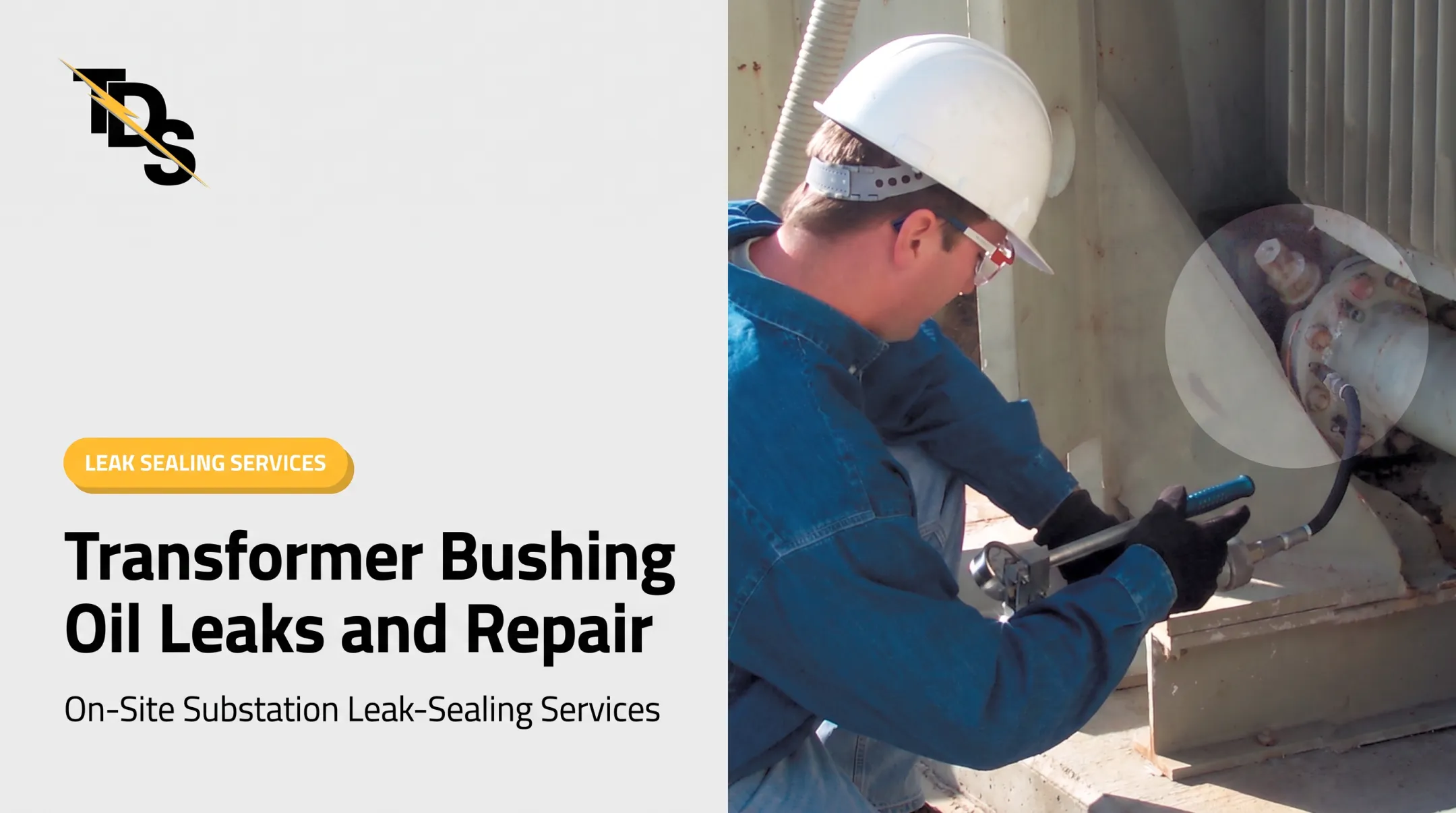
Transmission & Distribution Services (TDS) provides low-pressure leak sealing for oil-filled substation apparatus. In one case, a Westinghouse 2300 bushing leaked between the porcelain and base mounting flange. Technicians fitted a two-piece aluminum clamp and injected a proprietary rubber-based sealant.
Where site conditions allow, repairs like this can be done without teardown and sometimes with equipment energized. TDS also offers a free substation survey that documents each leak, repair method, and price.
This service doesn't repair structurally failed porcelain or replace a bushing. Before applying sealants or disturbing hardware, get a survey or consult a bushing specialist. Factor in spill containment, including SPCC obligations under 40 CFR Part 112 where they apply, and the manufacturer's repair limits.
Conclusion
Treat oil-filled porcelain bushings as engineered electrical, mechanical, and sealing assemblies, not interchangeable ceramic parts chosen by outside dimensions or price.
In practice:
- Confirm the design and dimensions
- Match electrical and environmental requirements
- Inspect for early leaks and damage
- Use qualified support for repair, replacement, or leak-sealing decisions
Frequently Asked Questions
What is the purpose of a bushing on a transformer?
It carries a conductor through the grounded tank while providing electrical insulation, mechanical support, and, where applicable, an oil-tight barrier.
What are the two main types of transformer bushings?
Non-condenser (solid) bushings and condenser (capacitance-graded) bushings. Material and oil arrangements create further categories.
What are porcelain bushings?
They are bushings that use glazed electrical porcelain as the external insulating and structural housing. Both oil-filled and dry configurations exist.
What is the difference between a bushing and an insulator?
An insulator supports or separates conductors. A bushing is a specialized insulated passage that lets a conductor cross a grounded barrier.
What are the standard dimensions for bushings?
There are none that apply universally. Dimensions must match voltage, current, flange, opening, terminal, clearances, and gasket, confirmed on an approved drawing.