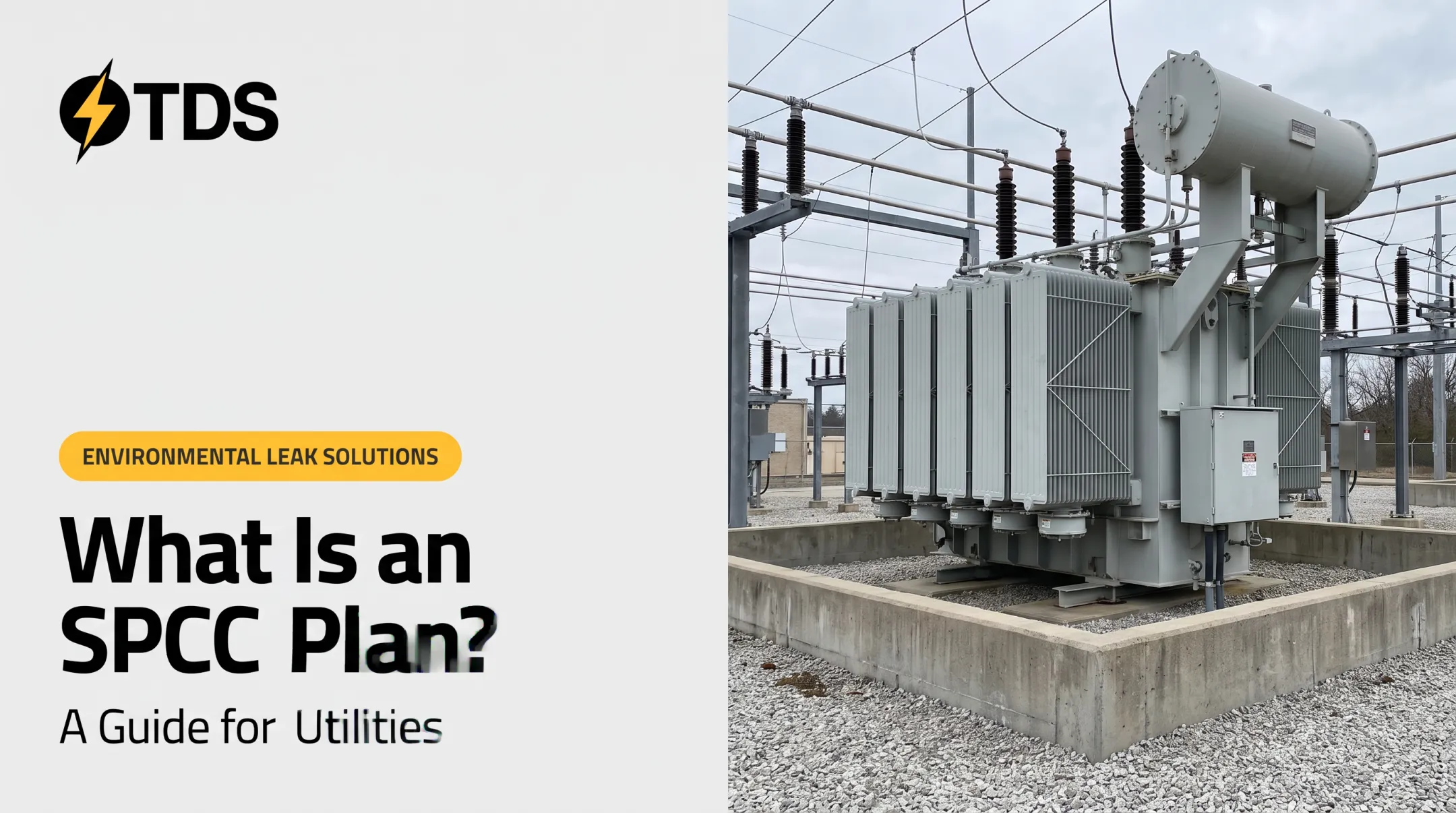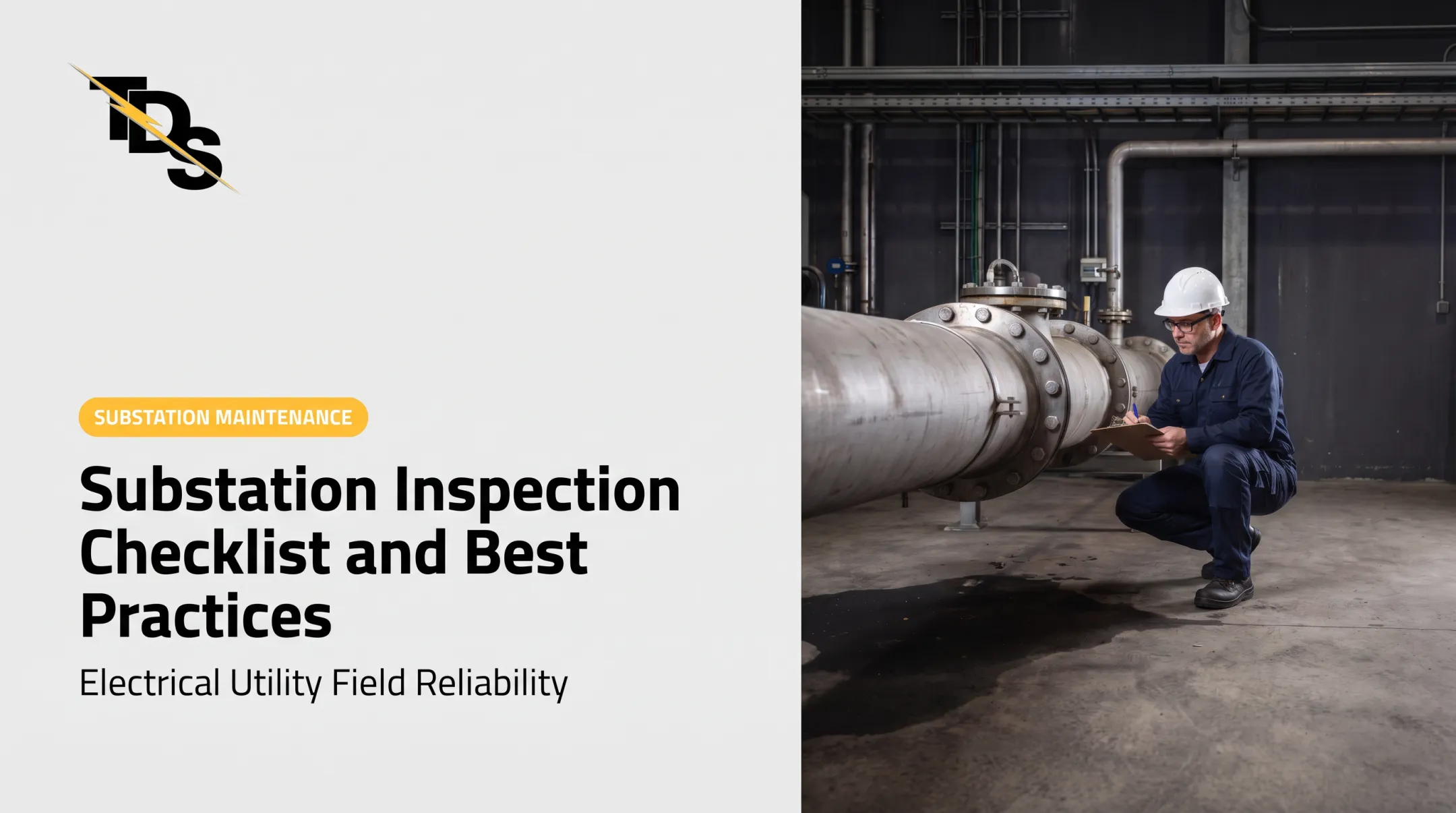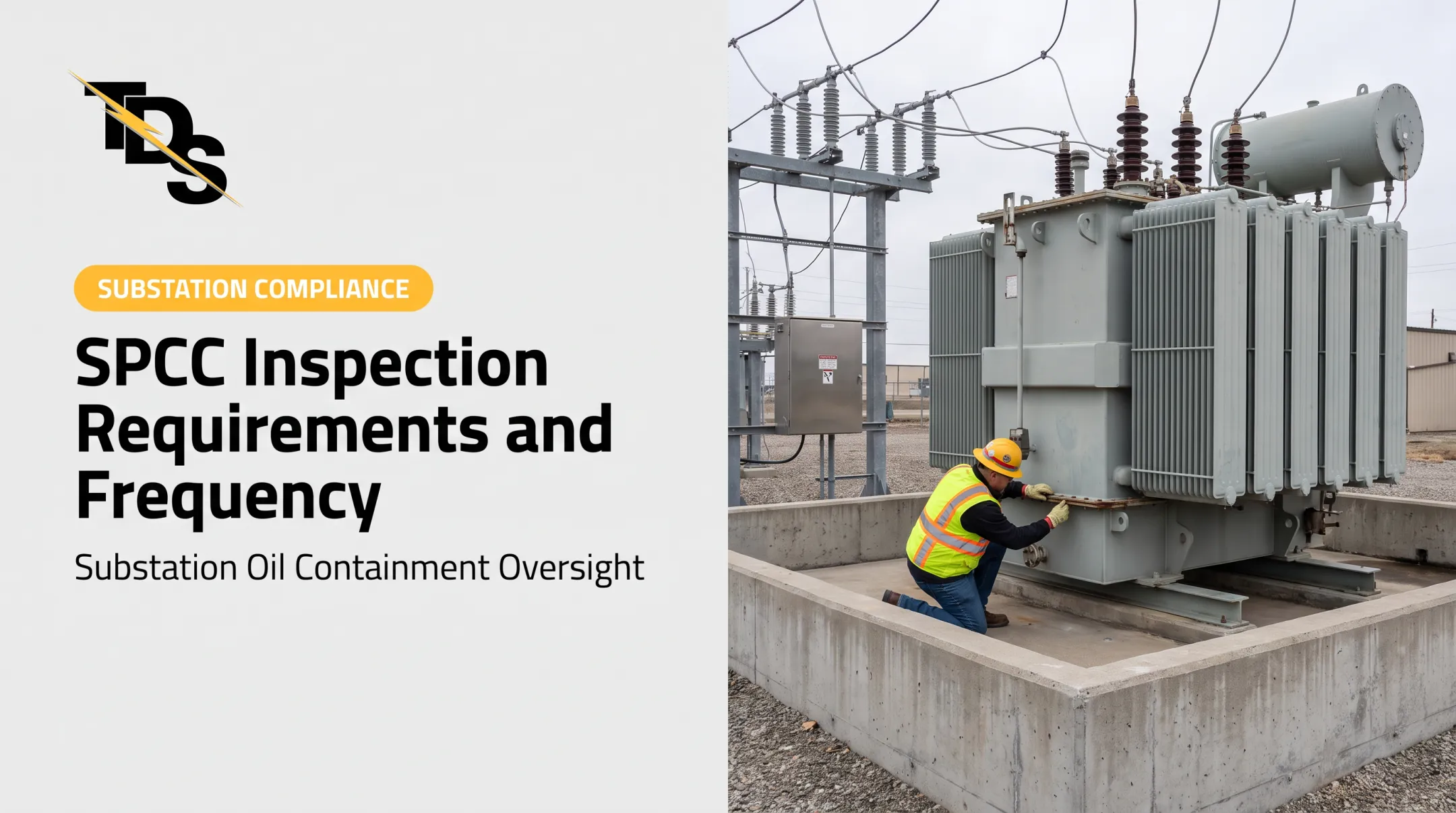

The common failure points are familiar: transformer oil seeping past aged gaskets and valve packing, containment with reduced capacity, blocked drainage paths, gaps in inspection records, and crews working near energized equipment without clear boundaries. Under EPA guidance, an inspection can quickly turn into a review of your records.
This checklist covers applicability, equipment, containment, drainage, spill response, training, documentation, and corrective-action follow-through.
Key Takeaways
- Base every field inspection on the current SPCC plan, site diagram, oil inventory, and written procedures.
- Inspect containment, drainage, transfer areas, spill kits, and records, not just tank exteriors.
- Log findings by asset and track each corrective action to verified completion.
- Treat SF6 leaks as a separate compliance issue from SPCC oil controls.
SPCC Requirements for Substations
Does the rule apply to your site?
Under 40 CFR 112.1, a non-transportation facility is covered when both conditions are met:
- A discharge could reasonably be expected to reach navigable waters or adjoining shorelines.
- Aboveground oil storage capacity totals more than 1,320 gallons, or completely buried storage exceeds 42,000 gallons.
Count the capacity of containers rather than the oil currently in them, and include every container of 55 gallons or more. Oil includes mineral and dielectric oil. Manmade containment gets no credit in the location assessment.
Substation oil sources to inventory
- Oil-filled operational equipment: transformers, circuit breakers, electrical switches, regulators, and capacitors
- Spare equipment stored on site
- Drums, totes, and maintenance reservoirs
- Oil staged for servicing
Operational equipment is not a bulk storage container, but EPA confirms that units of 55 gallons or more count toward facility capacity. Portable containers of 55 gallons or more count too, and they generally need secondary containment sized to the largest container plus precipitation freeboard.

SF6 is a separate issue
EPA describes SF6 as a synthetic fluorinated gas, distinct from the oils listed in §112.2. SF6-filled equipment may fall under emissions reporting or utility programs. Your SPCC checklist should name the oil-containing equipment and pathways it covers. Leave gas leaks to those programs.
Verify the plan matches the site
Before inspecting, confirm these elements still match current operations:
- Site diagram, oil inventory, and drainage map
- Containment descriptions, procedures, and emergency contacts
- Certification status
Qualified facilities (aggregate aboveground capacity of 10,000 gallons or less, plus a clean spill history) may self-certify under §112.6. Other plans need Professional Engineer certification.
Some operators of oil-filled equipment use the §112.7(k) alternative to general containment. That route requires documented inspections or monitoring and a contingency plan, so confirm which path your plan follows.
SPCC Inspection Checklist for Substations
Plan, inventory, and site conditions
- Confirm authorized personnel can access the current plan.
- Check that the diagram shows each regulated container, transformer, oil-filled breaker, transfer area, containment structure, drain, sump, outfall, and likely discharge path.
- Record new, relocated, retired, or repurposed equipment, changed capacities, regrading, construction, or altered drainage.
- Give every asset a clear identifier so findings tie to the right transformer, breaker, or containment area.
Oil-filled transformers and apparatus
Inspect tanks, radiators, conservators, bushings, gauges, valves, flanges, welds, covers, and sampling points for:
- Active leaks, staining, or residue
- Corrosion or mechanical damage
- Deteriorated seals
Check oil-filled breakers, regulators, operating mechanisms, and piping for seepage that could become a release. EPRI's 2006 transformer report notes that seal and gasket leakage should be detectable through walkdowns and oil analysis.
Valve packing deserves a close look. Deteriorated packing on flapper and butterfly valve stems is a common leak source, and extra bolt tightening rarely fixes it.
Safety first. Qualified personnel must set electrical safety boundaries, access limits, PPE, and any de-energization or energized-work controls before inspection or repair. OSHA 1910.269 permits only qualified employees to work on exposed energized equipment.
Use photographs and precise asset references to separate an active leak from an old stain, construction residue, or rainwater.
Secondary containment
- Examine berms, curbs, dikes, liners, sumps, vaults, and catch basins for cracks, erosion, settlement, holes, coating failure, or accumulated oil.
- Verify drains, valves, plugs, and pumps are set as the plan specifies.
- Confirm stored materials, vegetation, sediment, ice, or debris do not reduce capacity or block valve access.
Section 112.8(c)(2) requires containment for the largest single container plus enough freeboard for precipitation. The rule sets no numeric freeboard, so the final evaluation rests on your design and engineering basis.
Diked-area drains must use manual open/closed valves; flapper valves are prohibited. Inspect retained rainwater before release and keep records.
Drainage pathways
- Inspect storm drains, ditches, culverts, swales, outfalls, oil-water separators, and low points for sheen, staining, blockage, or erosion.
- Confirm drain covers, shutoff valves, diversion structures, and absorbent barriers are present, labeled, and usable.
- Compare actual drainage against the plan diagram, noting new paving, grading, or nearby waterways.
Oil handling and transfer areas
- Inspect hoses, pumps, fittings, valves, temporary connections, drip pans, and portable containers for leaks, corrosion, and impact damage.
- Verify filling, draining, sampling, and filtering follow written procedures under trained supervision.
- Check overfill prevention and level indication where applicable, and log failed or overdue tests.
- Brief contractors and testing crews on spill-prevention procedures before oil work starts.
Spill-response equipment
- Inventory absorbents, booms, drain covers, overpack and waste containers, shovels, labels, and PPE against the plan's spill scenarios.
- Confirm kits are marked, reachable from oil equipment, protected from weather, and restocked after use.
- Check posted emergency contacts, site access instructions, and maps for outdated information.
Inspection Frequency, Records, and Corrective Actions
Frequency and scope
No single schedule fits every substation. Frequency follows your plan, good engineering practice, equipment condition, and operating risk. EPA's inspector guidance describes routine visual inspections by qualified personnel; industry practice often means monthly, but that is not a CFR deadline.
Distinguish between:
- Routine visual checks
- Documented SPCC inspections
- Integrity testing of bulk containers
- Post-maintenance inspections
- Event-triggered inspections after storms, spills, construction, or equipment changes
Under §112.7(e), inspections follow written procedures, and records signed by the supervisor or inspector stay with the plan for three years.
What each record should hold
- Facility, date, time, and inspector
- Weather or site conditions when relevant
- Asset or location and checklist result
- Observed condition, with a photo or measurement
- Immediate controls applied
Add a finding class such as acceptable, monitor, corrective action required, or immediate spill risk. Define your own classes and response times.
Corrective-action tracking
Turn each deficiency into an action that includes:
- Owner and priority
- Target date and work-order number
- Interim control
- Verification method
Escalate immediately for active releases, failed containment, blocked emergency controls, or any condition that could carry oil to a drain or waterway. Follow site emergency and reporting procedures.
Then close the loop: document the repair, attach evidence, and have a qualified reviewer confirm the fix. Marked complete is not the same as corrected.

Plan review and amendment
Review the plan at least every five years and sign a statement on whether it will be amended. A material change that affects discharge potential triggers an amendment within six months.
Examples include new or relocated transformers, modified containment, and altered drainage. Technical amendments need PE certification except where §112.6 allows self-certification.
Not every inspection finding requires a revision. Start each inspection by asking: Does the written plan still describe the equipment, oil inventory, discharge pathways, procedures, and responsible personnel at this substation?
Separately, a single discharge over 1,000 gallons, or two over 42 gallons within 12 months, requires a report to the EPA Regional Administrator within 60 days.
Specialized leak follow-up
Recurring seepage should prompt root-cause analysis, not another wipe-down.
Transmission & Distribution Services (TDS) offers a free substation survey that documents and photographs each leak. The spreadsheet lists:
- Location and equipment
- Leak description
- Repair method
- Itemized cost
- Outage requirements
TDS also performs low-pressure leak sealing on eligible transformers and oil circuit breakers, sometimes while energized. Feasibility depends on site, equipment, and safety conditions.
Leak sealing supports corrective action. It does not replace your inspections, records, reporting, or plan management.
Spill Response, Training, and Audit Readiness
A five-step response framework
No federal regulation prescribes five steps. This is a practical organizing sequence. Your SPCC plan, emergency action plan, and utility procedures still control the response:
- Protect people. Establish electrical safety boundaries first.
- Stop the source when it is safe to do so.
- Contain the oil and protect drains and waterways.
- Notify internal contacts and regulators. A harmful-quantity discharge to navigable waters, including any sheen, requires an immediate call to the National Response Center at 800-424-8802.
- Recover, document, report, and review the incident.

Only qualified, authorized personnel should approach leaking or damaged energized equipment.
Training and drills
Section 112.7(f) requires training for oil-handling personnel on equipment operation, discharge procedures, applicable pollution rules, and the plan. It also requires a designated person accountable for discharge prevention and annual discharge-prevention briefings.
- Verify that operations, maintenance, contractor-management, and response staff know spill-kit locations, containment controls, and emergency contacts.
- Keep records with names, dates, topics, facilitator, and follow-up actions.
- Use drills and tabletop exercises to test access, communications, drain protection, and coordination between environmental, operations, and electrical teams.
Audit-ready checklist management
Use a controlled checklist that captures:
- Pass/fail/not-applicable status with comments
- Photos, asset IDs, and signatures
- Corrective-action assignments and work-order links
Before an audit, reconcile checklist history with the current plan, inventory, open deficiencies, training records, spill-kit inventory, and review status. TDS documentation has helped utility managers show EPA inspectors they have their arms around the problem.
Conclusion
A substation SPCC inspection works only when field observations lead to prevention controls, timely repairs, trained people, and reliable records. Adapt this checklist to your equipment, drainage, oil inventory, and electrical safety program. For complex conditions, bring in qualified environmental or engineering support.
Frequently Asked Questions
How often must an SPCC plan be reviewed?
At least every five years, with a signed statement on whether the plan will be amended. Separately evaluate amendments after material changes. Verify current requirements in 40 CFR Part 112.
What type of inspections does the SPCC plan require?
Written-procedure inspections and testing of bulk containers, containment, drainage, piping, and transfer systems. Operational equipment under §112.7(k) uses documented failure or discharge monitoring.
What should be included in an inspection checklist?
Plan and inventory review, transformers and oil-filled breakers, containment, drains, transfer areas, spill kits, training and records, findings with photographs, and corrective-action tracking.
What items would lead a facility to be subject to the SPCC rule?
More than 1,320 gallons of aboveground oil capacity (counting containers of 55 gallons or more), or 42,000 gallons buried, plus a reasonable expectation of discharge to navigable waters. Confirm with current EPA guidance.
What are the 5 steps of spill response?
Protect personnel, control the source, contain the spill, notify and report, then clean up and document. Your SPCC and site emergency procedures govern these steps.
What is a spill kit checklist?
Absorbents, booms, drain covers, overpack or waste containers, PPE, cleanup tools, labels, and emergency contacts. Confirm kits are accessible, inspected, and replaced after use.