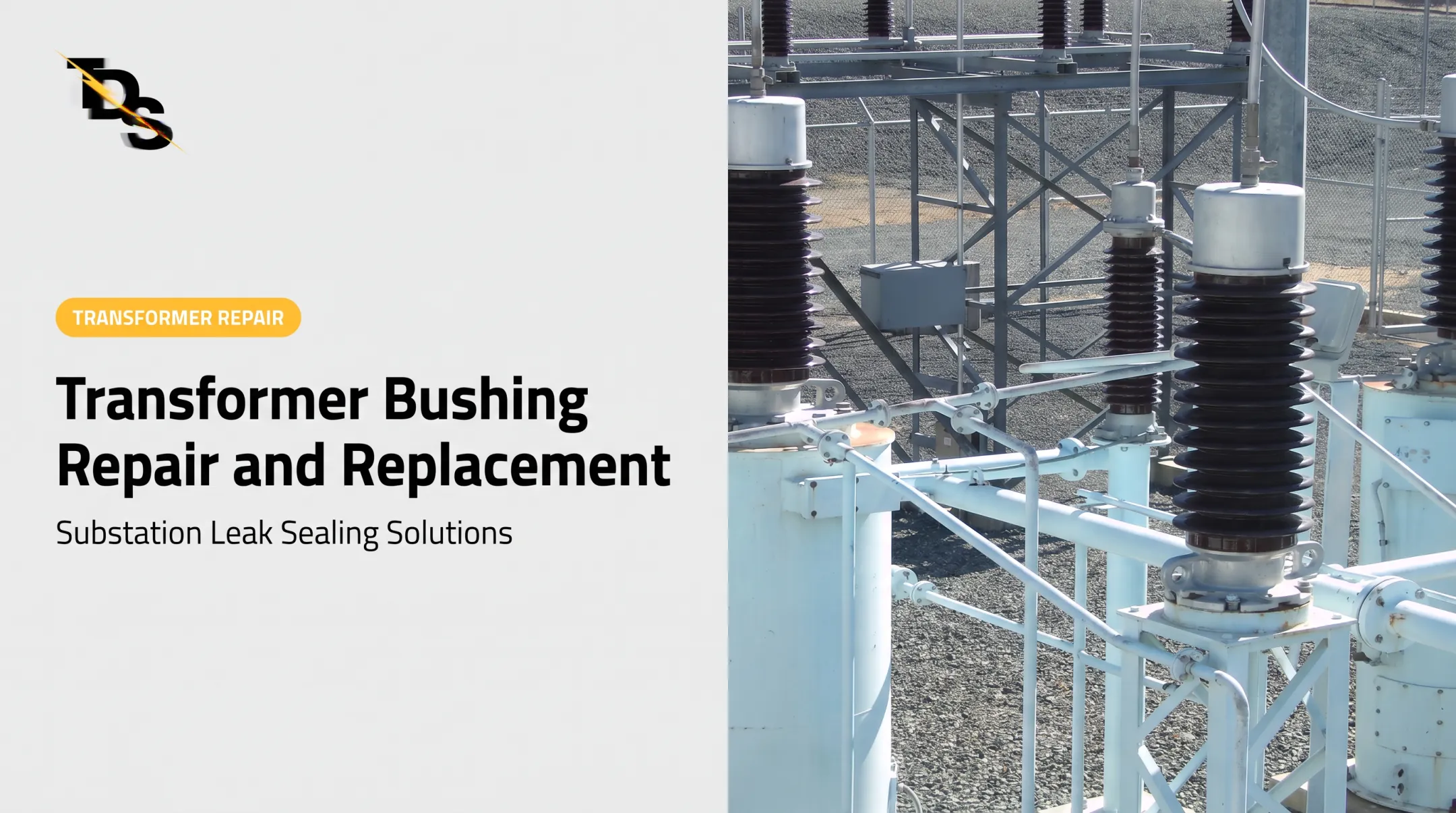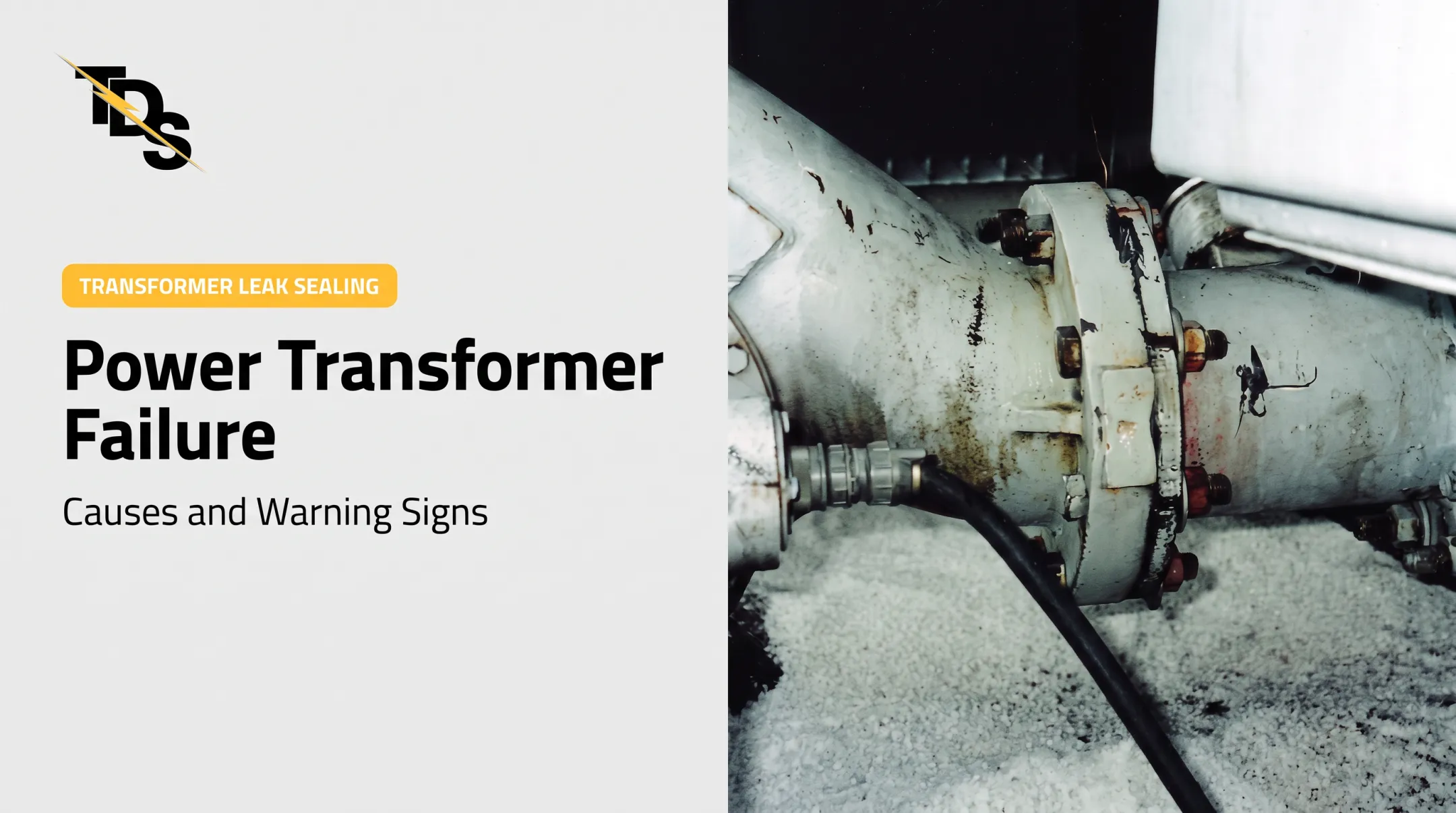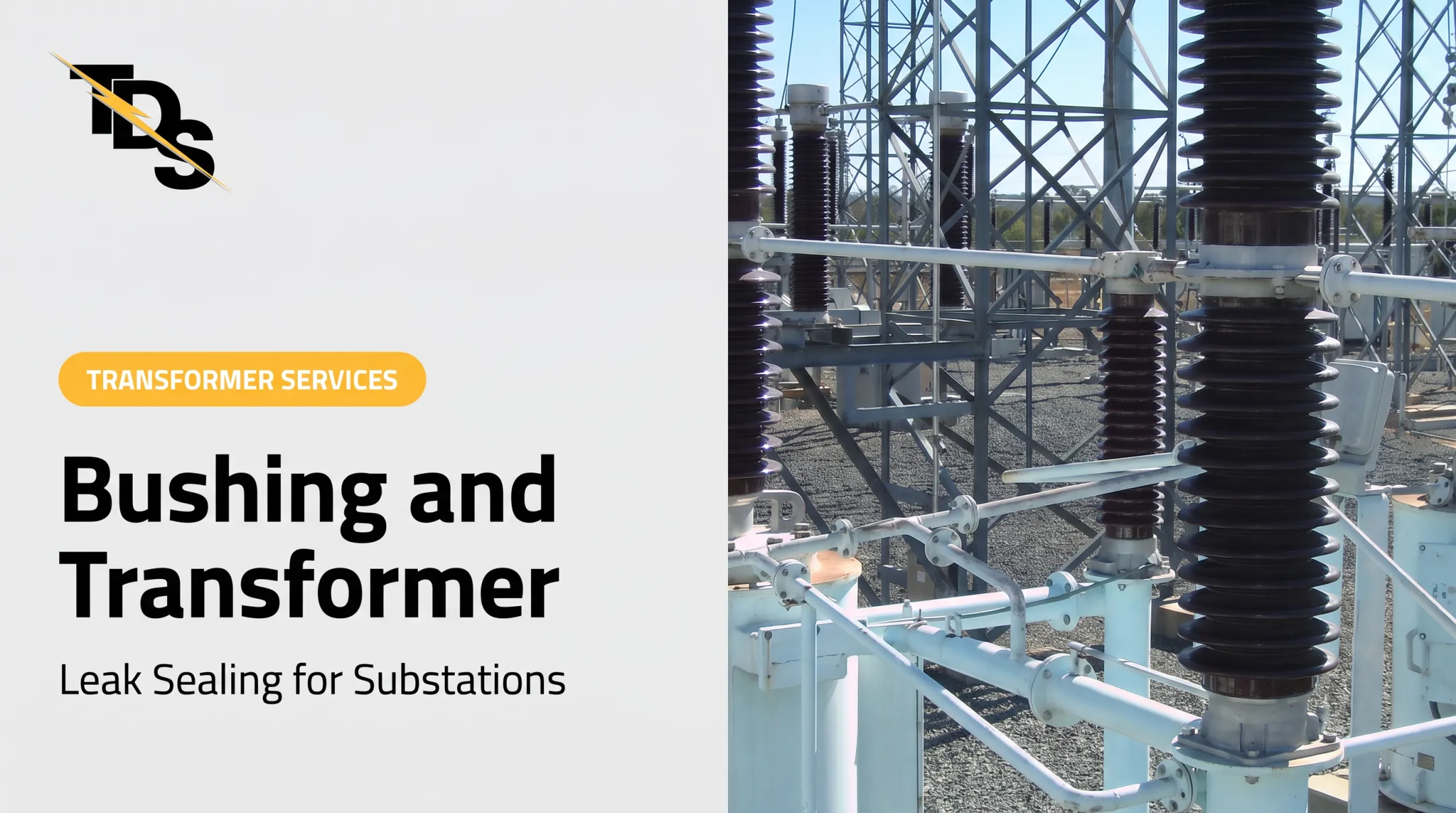

When it doesn't, a small leak, crack, or odd test result can turn into insulation breakdown, flashover, transformer damage, an unplanned outage, or an oil release. CIGRE's 2025 working group proposal puts bushings behind about 25% of transformer failures.
This guide covers what causes bushing failure, what happens when it's ignored, the warning signs, and how to prevent it.
Key Takeaways
- Most failures stem from moisture, aging seals, heat, electrical stress, contamination, or mechanical and manufacturing defects.
- Early signs include leaks, cracks, hot spots, tracking, noise, and drifting power factor or capacitance.
- Judge test results against baseline data, the nameplate, and manufacturer guidance, not a single universal limit.
- Inspection, trending, and timely repair or replacement limit cascading damage.
Common Causes of Transformer Bushing Failure
A bushing is an insulated assembly with a central conductor, an insulating body (often a paper or resin condenser core), an external housing of porcelain or silicone composite, a flange, gaskets, and terminals. Each of those parts is a possible failure point.
Moisture Ingress and Seal Deterioration
Original gaskets reach end of life, harden, and stop sealing the flange. Poor installation or defective gasket material speeds that up. Megger notes that failed gaskets can let moisture in to the tap compartment and outer core layers.
Two problems get confused here:
- An external oil leak is visible at the flange and may be a sealing issue only.
- Internal insulation deterioration shows up in electrical tests, often before anything is visible outside.
Thermal Stress, Overloading, and Poor Connections
Sustained overloads, weak cooling, and high ambient temperatures all age insulation faster. So do loose or corroded terminal connections, which create localized hot spots.
A unit that cycles hard between light and heavy load stresses its seals and insulation repeatedly. A single bad terminal connection can overheat a bushing from the top down until it fails.
Electrical Stress, Surges, and Partial Discharge
Overvoltage, switching or lightning surges, internal voids, and weakened insulation damage the dielectric system. Partial discharge often starts small, as tiny localized sparks erode insulation bit by bit. Over time, the damage bridges capacitive layers, and a puncture, short circuit, or flashover follows.
Contamination, Surface Tracking, and Flashover
Salt spray, cement dust, industrial pollution, and chemical or biological deposits coat the external sheds. Add moisture and the surface becomes conductive. Leakage current leaves black tracking marks, and flashover can follow.
Mechanical Damage, Installation Errors, and Aging
- Cracked or chipped porcelain or polymer from transport or impact
- Excessive conductor loading, vibration, or seismic movement
- Wrong mounting torque or misalignment
- Manufacturing defects such as voids or incomplete curing
- Normal material aging
Not every failure has a clean explanation. NRC records on a 2007 Indian Point 3 bushing fault left the root cause indeterminate, even though earlier thermography and power factor results were acceptable.
What Happens If Transformer Bushing Failure Is Ignored
The typical progression runs from an unresolved leak, crack, hot connection, or worsening test trend to moisture ingress, then insulation breakdown, flashover, and a transformer fault.

Fire risk, extended outage, equipment replacement, and oil release can follow. Actual consequences depend on the failure mode and the equipment's condition.
Two NRC-documented Indian Point events show how far it can go:
- 2007: A 345 kV Phase B bushing failure caused a reactor trip and a transformer fire.
- 2010: A Phase B bushing fault caused rapid pressure rise, tank failure, explosions, and a reactor trip. Roughly 50 to 100 gallons of oil reached the Hudson River.
These cases show escalation is possible. They do not mean every bushing issue ends this way.
Smaller leaks carry their own cost. Conventional repair typically requires:
- De-energizing and grounding the transformer
- Draining the oil
- Disassembling the unit
An unchecked oil leak can also leave a utility exposed to EPA inspection findings and significant fines.
Warning Signs You're About to Experience Transformer Bushing Failure
Treat every sign below as a trigger for documented inspection and qualified evaluation. Appearance alone can't prove a bushing is safe or unsafe, and normal-looking equipment can still fail. Acceptable test results preceded the 2010 Indian Point failure.
Oil Leaks, Oil-Level Changes, or Damaged Seals
Look for these signs on oil-impregnated bushings:
- Oil film or drips near the flange
- Hardened gaskets and corrosion
- Level changes beyond normal temperature-related swings
Visual inspection often can't pinpoint the exact leaking component, so confirm the source before choosing a fix. An external flange leak may be repairable. Internal leakage or insulation damage needs deeper technical assessment.
Cracks, Chips, Discoloration, and Physical Deformation
Cracked or chipped porcelain or polymer, damaged sheds, darkened surfaces, and distorted hardware point to mechanical, thermal, or environmental stress. Never approach or touch energized equipment to investigate. Document from a safe distance.
Hot Spots, Surface Tracking, and Unusual Noise
- Infrared hot spots often indicate loose terminal connections. FM's data sheet endorses online thermography for this.
- Black tracking marks suggest contamination or surface discharge.
- Hissing, corona-like activity, or abnormal buzzing can signal partial discharge.
Qualified personnel should confirm each with proper procedures and instruments.
Abnormal Electrical or Condition-Monitoring Results
Watch for these condition-monitoring changes and trend them against the recorded baseline:
- Changing power factor or tan delta
- Unexpected capacitance shifts
- Partial-discharge indications
- Dissolved-gas findings where applicable
Megger associates capacitance increases with shorted layers, and decreases most often with tap-connection problems.
Thresholds are manufacturer-specific. One OEM manual, for example, calls for factory contact at power factor 1.5 times the original installation value or capacitance 10% above the original. That's an escalation trigger for that design, not a universal rejection limit.

How to Prevent Transformer Bushing Failure
Prevention works as a program: correct specification, safe installation, environmental control, routine inspection, diagnostic testing, and timely repair or replacement. No single test or walk-down covers it.
Establish a Baseline and Use Condition-Based Testing
Record commissioning values for power factor or tan delta and capacitance. Then trend them, along with temperature, oil condition, and partial-discharge indicators.
Intervals depend on the manufacturer, asset criticality, environment, and IEEE or IEC guidance. For reference, FM suggests testing OIP condenser bushings one year after commissioning, then offline tests about every three years. Those are insurer recommendations, not a statutory schedule.
Control Heat, Loading, and Connection Quality
- Verify loading and cooling performance
- Check terminal tightness, conductor alignment, and grounding
- Look for corrosion
- Run thermal scans and inspect during planned maintenance
Manage Moisture, Contamination, and the External Environment
Clean according to bushing material:
- Porcelain under salt or dust exposure needs regular cleaning
- Silicone surfaces need a gentler approach: a non-fraying cloth, a non-aggressive agent, and low effort, because cleaning affects hydrophobicity
Inspect sheds, weather seals, and enclosures. Don't clean or test energized equipment unless the procedure is specifically approved and controlled.
Repair Confirmed External Leaks and Plan Replacement When Needed
Find the exact leak source first. Then sort the problem:
- Accessible gasket or flange leak: may be a candidate for external sealing.
- Cracked housing, internal oil loss, abnormal electrical results, or flashover damage: likely needs major repair or replacement.
FM recommends replacing OIP condenser bushings with significant oil leaks.
For qualifying external flange leaks, Transmission & Distribution Services (TDS) offers low-pressure leak sealing as an alternative to teardown. Technicians drill the flange gasket and inject a sealant that cures in place as replacement gasket material.
Where sealant can't travel the groove, they measure and build a clamp around the flange split line, then drill and inject the bolt holes. TDS documented a Westinghouse 2300 bushing base flange leak repaired this way with a two-piece aluminum clamp.

Suitability depends on site conditions, safety procedures, equipment compatibility, and qualified assessment. It addresses external sealing only, not internal insulation damage.
Tips for Long-Term Prevention and Control
Establish Clear Inspection, Escalation, and Training Standards
- Schedule routine visual walk-downs from safe distances
- Define escalation thresholds in writing
- Train technicians to recognize leaks, tracking, and hot spots
- Set instructions for removing equipment from service when a serious hazard is suspected
Maintain Complete Asset and Repair Records
Document bushing type, nameplate data, installation date, test baselines, load and environmental conditions, leaks, cleanings, repairs, and replacement decisions. Future teams can then spot recurring causes.
TDS surveys follow the same logic, listing location, equipment, leak description, repair method, itemized cost, and outage requirements, with photographs of each leak.
Use Monitoring Technology and Replacement Planning Strategically
Online bushing monitors, infrared imaging, and portable diagnostics earn their place on critical units. Anomaly detection is not diagnosis. Also review spares. Hitachi's U.S. preliminary table listed 36 weeks for GOB+ bushings and 25 weeks for GOE up to 1675 as of its latest update, though final timing follows the order. Plan end-of-life replacement before you need it.
Conclusion
Bushing failures usually have identifiable electrical, thermal, environmental, mechanical, sealing, or aging causes. Visible signs and drifting test results deserve a response, not a shrug.
Disciplined inspection, baseline trending, safe maintenance, and prompt qualified action keep a bushing issue from becoming a transformer outage. When the confirmed problem is limited to a suitable external seal or flange leak, TDS's low-pressure sealing may be worth evaluating.
Frequently Asked Questions
What are the common causes of transformer bushing failure?
Moisture ingress, seal aging, overheating, electrical stress, partial discharge, contamination, mechanical damage, installation errors, and aging. Pinning down the exact cause requires equipment-specific evaluation.
What is a transformer bushing?
An insulated assembly that lets a conductor pass through a grounded transformer tank without touching it. It also provides mechanical support and environmental sealing.
What are the warning signs of transformer bushing failure?
Oil leaks, cracks, discoloration, hot spots, tracking marks, unusual noise, and changing test results. Have qualified personnel assess any suspected defect.
How are transformer bushings tested for failure?
Common methods are visual inspection, infrared scanning, power factor or tan delta, capacitance, partial discharge, and oil or dissolved-gas analysis where applicable. Selection and interpretation depend on bushing type and manufacturer guidance.
Can a leaking transformer bushing be repaired?
Some confirmed external gasket, flange, or seal leaks can be repaired. Cracked housings, internal insulation deterioration, flashover damage, or abnormal electrical results may require replacement or major repair.
What should you do if you see a cracked or leaking transformer bushing?
Keep personnel away and follow site electrical safety procedures. Document from a safe location, notify qualified maintenance staff, and arrange testing or outage planning. Don't attempt an unapproved repair.