
An SF6 circuit breaker does that job using sulfur hexafluoride as both the insulating medium and the arc-quenching medium. This article covers construction, operating sequence, types, ratings, applications, maintenance, leak handling, and the environmental rules US owners now face.
Key Takeaways
- Sealed SF6 breakers carry load current and interrupt fault current under control.
- Compact, reliable designs still need active management of leaks, arcing by-products, and gas recovery.
- Follow the OEM manual, nameplate ratings, and applicable US federal and state rules.
What Is an SF6 Gas Circuit Breaker?
An SF6 breaker has two jobs. It carries current during normal operation, and it interrupts current when protection systems detect a fault or when planned switching is required.
Why SF6 Works
SF6 is electronegative, meaning it captures free electrons. NIST's gas insulation study reports a breakdown voltage nearly three times that of air at atmospheric pressure. The same study notes that strong thermal conductivity and fast thermal and dielectric recovery aid arc interruption. That high dielectric strength is also what allows compact equipment design.
Main Components
- Fixed and moving contacts, plus arcing contacts that take the arc
- Interrupter chamber, nozzle, and gas-flow paths
- Sealed gas enclosure and bushings
- Operating mechanism
- Density or pressure monitoring
- Control circuitry
The sealed enclosure keeps the gas away from outside contamination. Enclosure design varies by manufacturer and voltage class, so check the OEM drawings for any specific unit.
Pure Gas vs. Arced Gas
Uncontaminated SF6 is nonflammable, colorless, and odorless. It is also about five times heavier than air, so it can pool in confined or below-grade spaces.
Arcing changes that profile. The EPA describes toxic sulfur-fluoride gases and metal-fluoride solids after intense arcing. With moisture present, hydrofluoric acid can form. White or gray powder, or a pungent odor, can signal by-products. Consult the safety data sheet and use qualified handling procedures.
How Does an SF6 Circuit Breaker Work?
Closed Position
Contacts carry current. The interrupter holds SF6 at the manufacturer-specified density, and monitoring confirms the breaker is ready to operate.
Fault Sequence
- A relay detects the fault and energizes the trip coil.
- The operating mechanism moves the contacts.
- Main contacts separate and current transfers to the arcing contacts.
- An arc forms between them.
- SF6 flows across the arc, cooling it.
- Current is interrupted at a current zero.
- The widening gap regains dielectric strength and withstands the recovery voltage.
SF6 captures free electrons, which reduces the charge carriers sustaining the arc, and carries heat away. Exact interrupter behavior is model-specific.
Puffer vs. Thermal-Assisted Designs
In a puffer design, the moving assembly drives a piston that compresses SF6 and forces it through an insulating nozzle across the arc, as Schneider Electric describes. Thermal-assisted or self-blast designs rely more on arc heat to build pressure and move hot gas toward cooler regions at high current. Chamber and valve details differ by design, so use the OEM cross-section.
After the Trip
The contacts finish their travel, the gap recovers, and the mechanism resets or recharges its stored energy. Auxiliary contacts signal the open position, and gas density is verified. Where the installed scheme supports it, reclosing logic can then act. Rated duty such as O-CO-CO varies, so confirm it on the nameplate.
The full path runs closed, contact separation, arc and gas flow, extinction, then open.

Types, Construction, and Specifications of SF6 Circuit Breakers
Pressure-System Types
Two common pressure-system types are double-pressure and single-pressure (puffer) breakers. A PG&E presentation to an EPA workshop reports that early SF6 breakers used two-pressure systems and modern units use single-pressure designs.
PG&E removed its last two-pressure unit in 2006, though that timeline reflects one utility's history rather than a universal cutoff. Some manufacturers and textbooks use other categories.
Mechanism Types
Interrupter type and operating mechanism are separate classifications. The mechanism determines how energy is stored and delivered to the contacts. Common forms include:
- Spring
- Hydraulic
- Pneumatic
- Spring-hydraulic
One Fuji GIS example uses hydraulic actuation, so confirm the mechanism in the breaker's manual.
Construction Varies
SF6 breakers are built in several physical arrangements:
- Air-insulated or gas-insulated switchgear
- Indoor or outdoor installations
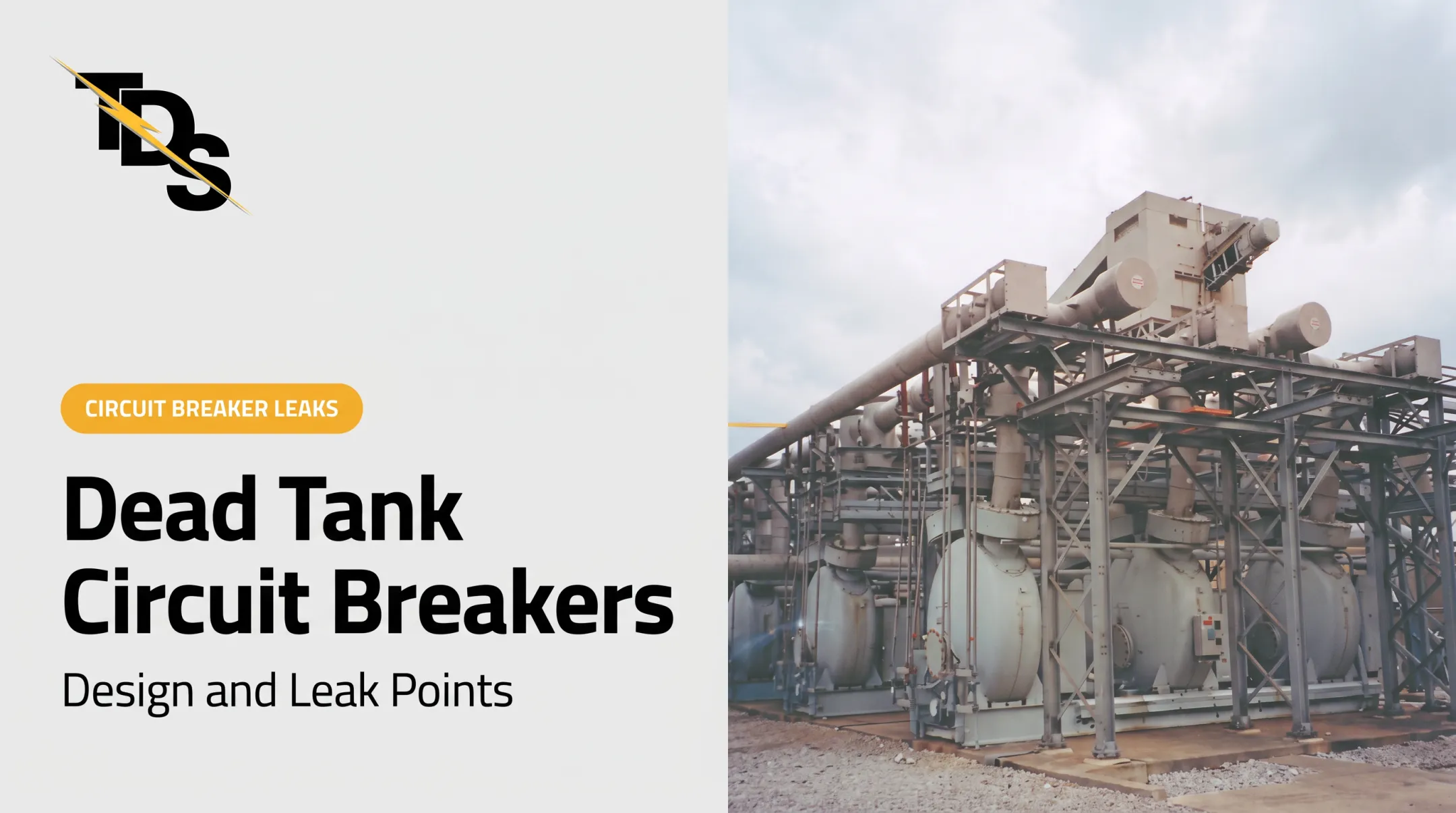
- Live-tank or dead-tank designs
- Multiple voltage classes
No single layout covers every application.
Specification Checklist
- Rated maximum voltage and continuous current
- Short-circuit (interrupting) rating and transient recovery voltage
- Insulation level and frequency
- Operating duty sequence
- Opening and closing times
- Gas density or pressure limits
- Control voltage
- Mechanical endurance
- Environmental conditions and leakage requirements
IEEE C37.04-2018 frames US ratings for AC high-voltage breakers above 1000 V. Take actual values from the OEM nameplate or datasheet.
Reading the Nameplate
Before selecting a breaker, run fault studies and check insulation coordination, altitude, ambient conditions, and space limits. Then coordinate the nameplate values with relay settings, transformer and bus ratings, grounding, and the wider substation design.
Applications, Advantages, Limitations, and Alternatives
Where They Are Used
- Line, transformer, reactor, and capacitor switching
- Utility substations and transmission and distribution switchgear
- Power plants
- GIS installations
Rating and configuration decide suitability. Generator breakers have their own standard framework, IEC/IEEE 62271-37-013.
Advantages
- Strong insulation and effective arc interruption
- Compact equipment
- Enclosed operation
- Lower fire hazard than oil-filled designs
Limitations
- Gas is expensive, and recovery and analysis need specialized equipment
- Ongoing leak monitoring and gas inventory tracking
- Arcing by-products can be hazardous
- SF6 has a 100-year GWP of 25,200 and a 3,200-year atmospheric lifetime, per IPCC AR6
- EPA's AR5-based GWP figure is 23,500; specify the assessment vintage when you report it
- Trained service personnel are required
Alternatives
Vacuum, air, oil, and newer lower-GWP designs compete on voltage class, interrupting duty, GIS or AIS layout, lifecycle cost, regulation, and OEM validation.
Siemens Energy and National Grid announced a vacuum-interrupter, clean-air Blue breaker project in Massachusetts. Evaluate SF6-free options as US rules tighten.
US Requirements
- Federal: EPA's GHGRP Subpart DD covers electrical transmission and distribution equipment. EPA's 2021 average emissions rate was 1.42%, an aggregate figure, not a breaker leak limit.
- California: CARB phases out acquisition of new SF6 gas-insulated equipment by voltage and interrupting rating, starting January 1, 2025 for units above 38 to 145 kV below 63 kA. Annual reports are due June 1.
- Massachusetts: a 1% annual leak-rate maximum for GIS purchased after 2015.
- New York: Part 495 sets a voltage-based phaseout beginning in 2027 and a 1% systemwide limit from 2030.
Check current rule text and utility obligations for your sites.
Maintaining, Testing, and Safely Handling SF6 Breakers
Maintenance Checklist
- Gas density or pressure readings
- Flanges, enclosure, and seams for leaks
- Bushings and insulators
- Contacts and mechanism condition
- Control wiring, heaters, trip and close circuits, and interlocks
- Contamination, powder, or physical damage
Testing
Typical tests include:
- Timing and travel
- Contact resistance
- Insulation or power-factor testing where applicable
- Functional trip and close checks
- Gas quality and moisture analysis
Bureau of Reclamation's FIST 3-16 covers timing, motion, and contact-resistance tests. Acceptance limits come from the manufacturer's manual. Set intervals using OEM guidance, duty, condition, and asset-management practice.
Safe Gas Handling
- Isolate and make equipment safe under the approved switching plan.
- Use trained personnel and required PPE.
- Test gas quality before opening if by-products are possible.
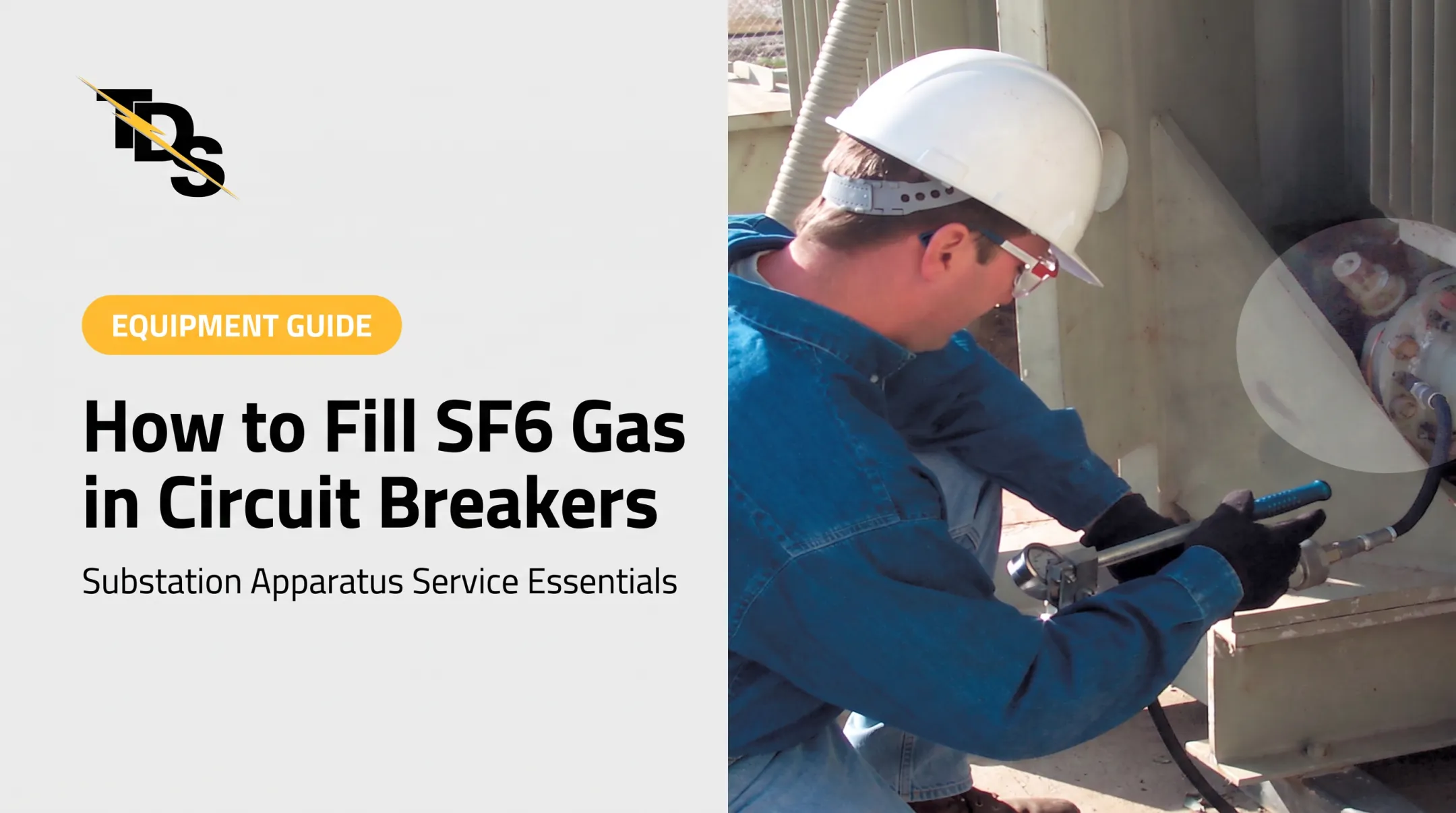
- Recover gas with suitable equipment. Never release it intentionally.
- Manage contaminated gas and materials through approved procedures.
IEC 62271-4 and IEEE C37.122.3 cover handling. OSHA's confined-space rules apply where gas can accumulate.
Catching Leaks Early
Temperature-compensated density monitors, portable detectors, visual checks, and documented trends reveal losses before density nears the operating threshold.
Wind, noise, or a rushed survey can make soap-solution, handheld, and ultrasonic methods unreliable. Infrared laser scanning detects the SF6 signature across an entire breaker and records the leak on video.

Leak Sealing With TDS
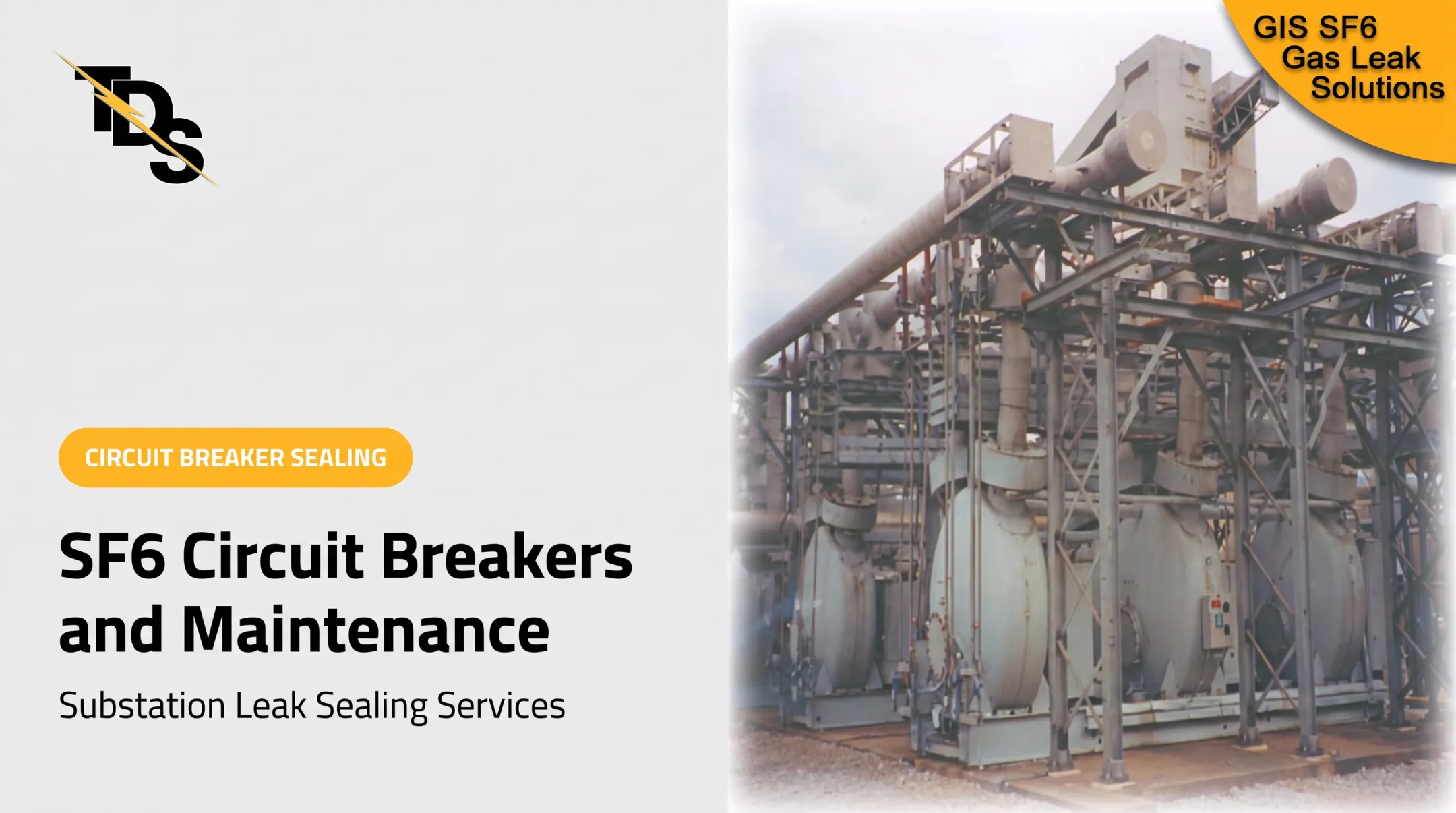
Transmission & Distribution Services specializes in SF6 breaker and GIS leak sealing. Typical leak points are porcelain-to-flange gaskets and bushing end caps.
- Free equipment survey: documents leak locations, repair methods, and itemized costs
- Method: low-pressure, cured-in-place gaskets replace failed OEM gasket material, often without disassembly
- Example: a porcelain-to-flange repair takes about four hours
- Warranty: four years on leak-seal repairs
Many repairs can be done with equipment energized, but only after a documented hazard assessment, customer approval, equipment-condition review, and applicable safety procedures.
Keep the Records
Document gas added or recovered, leak locations, test results, repairs, by-product controls, and return-to-service checks. That history supports reliability and environmental reporting.

Conclusion
An SF6 breaker is a coordinated system: interrupter, gas enclosure, contacts, mechanism, controls, protection, monitoring, and maintenance. Every part has to work together for safe, reliable interruption.
Reliable operation depends on correct ratings, OEM and qualified-person procedures, tight control of leaks and by-products, and a clear view of SF6-free alternatives as US requirements evolve.
Frequently Asked Questions
What is an SF6 circuit breaker?
A medium- or high-voltage circuit breaker that uses sulfur hexafluoride for insulation and arc quenching. It switches circuits and clears faults.
How does an SF6 circuit breaker work?
Contacts separate and an arc forms. SF6 flows across it, captures electrons, and cools it. The gap then regains dielectric strength.
Why is SF6 used in circuit breakers?
Its high dielectric strength, electronegativity, thermal properties, and arc-quenching performance allow compact equipment. Its climate impact demands careful handling.
What are the two types of SF6 circuit breakers?
Single-pressure (puffer) and double-pressure designs. Operating mechanisms are classified separately from the gas system type.
What are the specifications of an SF6 circuit breaker?
Voltage, current, interrupting rating, insulation level, gas density, operating times, control voltage, endurance, and environmental conditions. Take actual values from the OEM nameplate or datasheet.
What are SF6 circuit breakers used for?
They switch circuits under normal load and automatically isolate faults, protecting transformers, lines, busbars, generators, and other substation equipment.