
An oil leak detection system combines sensors, a monitoring panel, alarms, communications, and response procedures to find oil in containment areas or around protected equipment. This article covers the main sensor types, how to choose one, and what to do when an alarm trips.
Key Takeaways
- Continuous monitoring catches leaks between rounds, especially at remote or lightly staffed sites.
- The right system depends on oil type, containment design, environment, and required location accuracy.
- An alarm confirms oil was detected. It does not give you the source, volume, or repair method.
- Portable tools and leak-sealing services complement monitoring; they don't replace it.
Why Substations Need Oil Leak Detection
Transformer oil provides insulation and cooling, so losing it is a reliability problem as well as an environmental one. Escaped oil also creates housekeeping and maintenance headaches.
The regulatory side matters too. Under 40 CFR Part 112 (SPCC), oil-filled operational equipment such as transformers and circuit breakers can bring a facility into scope, depending on storage capacity and the potential for discharge to navigable waters. Two federal reporting tests are easy to confuse:
- A sheen on water can require an immediate report to the National Response Center, with no minimum gallon amount.
- A written SPCC report to the EPA Regional Administrator applies after a single discharge over 1,000 gallons, or more than 42 gallons in each of two discharges within 12 months.
Where visual rounds fall short
Rounds miss slow seepage, leaks hidden behind equipment, and oil that has already migrated into drains or containment. Unmanned sites go unseen for long stretches.
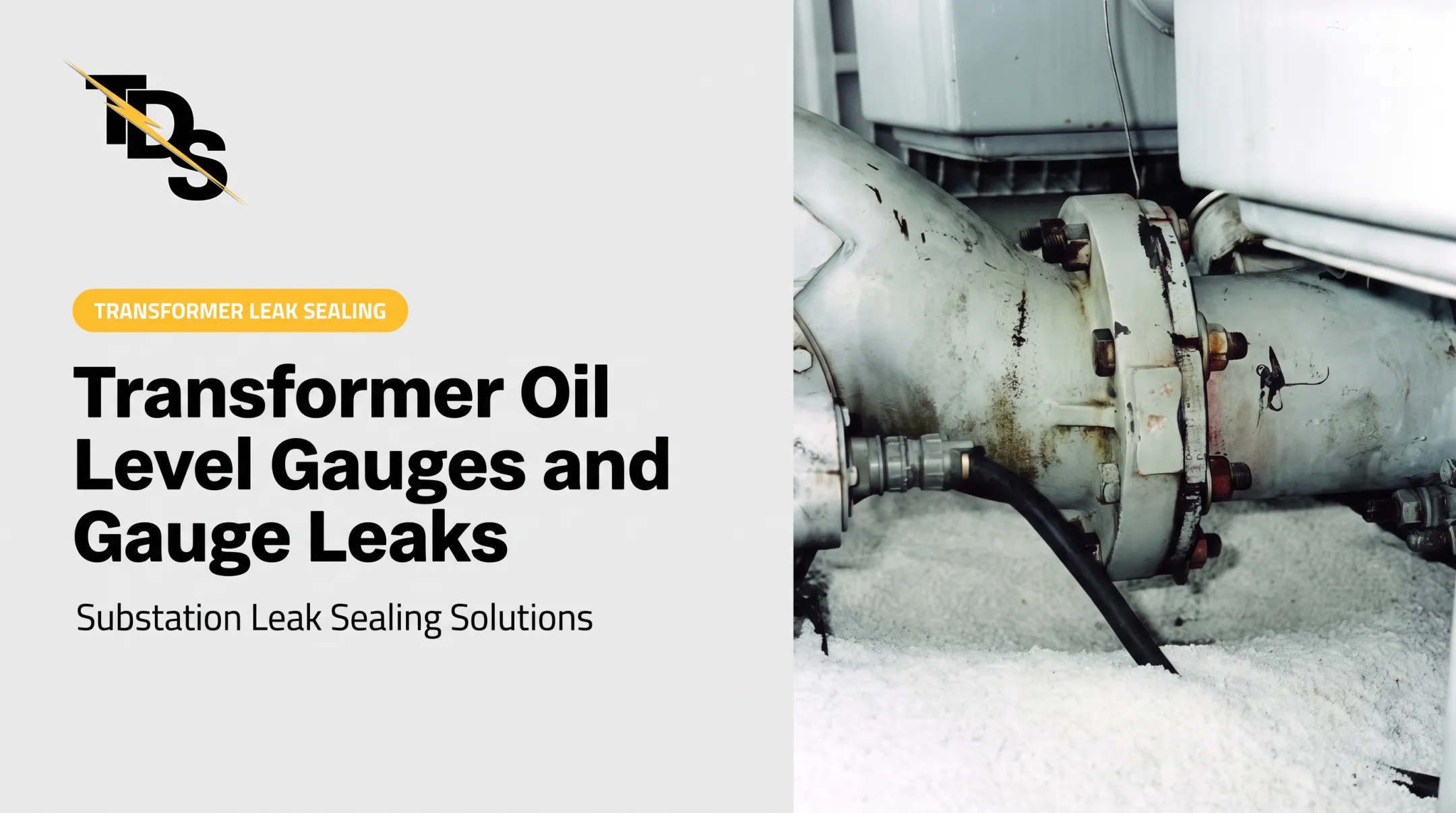
Even a visible stain can mislead: oil residue does not necessarily mean an active leak. TDS notes that at an 8-bolt connecting flange, visual observation alone often can't show whether the joint is actually leaking.
What early detection buys you
Earlier alarms mean faster investigation, a more precise location, and better spill-response decisions. They can reduce outage and cleanup exposure.
Utilities also face questions during EPA inspections about whether leaks are documented and an action plan is in place. Appalachian Power reported a 2026 transformer failure that released mineral oil outside a station. A spare transformer kept service running.
How Oil Leak Detection Systems Work
Core components
- Point or linear sensors
- A local controller or monitoring panel
- Power and communications
- Audible or visual alarms and event logging
- Optional links to SCADA, PLC, building-management, or remote notification systems
Sensing principles
Common sensing methods include:
- Optical: Infrared LED and prism; liquid contact changes how light reflects
- Resistive: Resistance changes when oil touches the sensor
- Hydrocarbon-selective cable: Detects oil along a continuous run
- Float and level: Responds once liquid has accumulated
Oil behaves differently from water, so match the sensor to your actual fluid. Ask the manufacturer for written confirmation on your insulating oil. Published specs vary. One resistive point sensor, the TRM-IOS, lists mineral transformer oil with response under 10 seconds at 20 °C, for dry indoor locations. Some addressable cables list hydrocarbons and water-insoluble liquids without stating a mineral-oil response time.

Placement
Common placement points include:
- Transformer containment areas, drip trays, and sumps
- Low points and oil-handling routes
- Breaker compartments where appropriate
- Oil/water separators
Final placement still needs equipment drawings, site conditions, and manufacturer or engineering review.
Location versus volume
Addressable systems identify a sensor or cable section. Simpler ones only say liquid reached a point. Neither measures how much oil escaped. Cable and controller specs cover detection and location, not spilled gallons.
Alarm logic and health monitoring
When you evaluate a system, confirm it supports:
- Leak alarms and cable or sensor fault alarms
- Confirmation settings and clear reset procedures
- Remote notification to operations staff
One example controller offers Modbus/JBUS over TCP/IP, relay outputs, email/SNMP notices, and a 5,000-event log, but not DNP3 or IEC 61850. Verify response times, thresholds, hazardous-area ratings, and protocols against current manufacturer documents.
Types of Oil Leak Detection Systems for Substations
Optical or point sensors
Good for containment areas, drip trays, and defined low points. They respond locally and fast. Limits: installation geometry, contamination, and oil spreading past the sensor. Confirm oil-versus-water discrimination on the product datasheet; not every optical sensor documents it.
Addressable sensing cable
Suited to perimeters, bunds, long runs, and irregular areas. It reports the affected section. Consider routing, impact protection, and cleanup. Some cables are reusable unless immersed for long periods; others are non-resettable after exposure. Don't transfer fuel-cable specs to transformer oil without confirmation.
Float, sump, and level systems
These work where oil collects to a measurable depth. They are simple and useful for larger releases, but respond later. Some sump products discriminate oil from water; basic floats may not.
Manual and portable methods
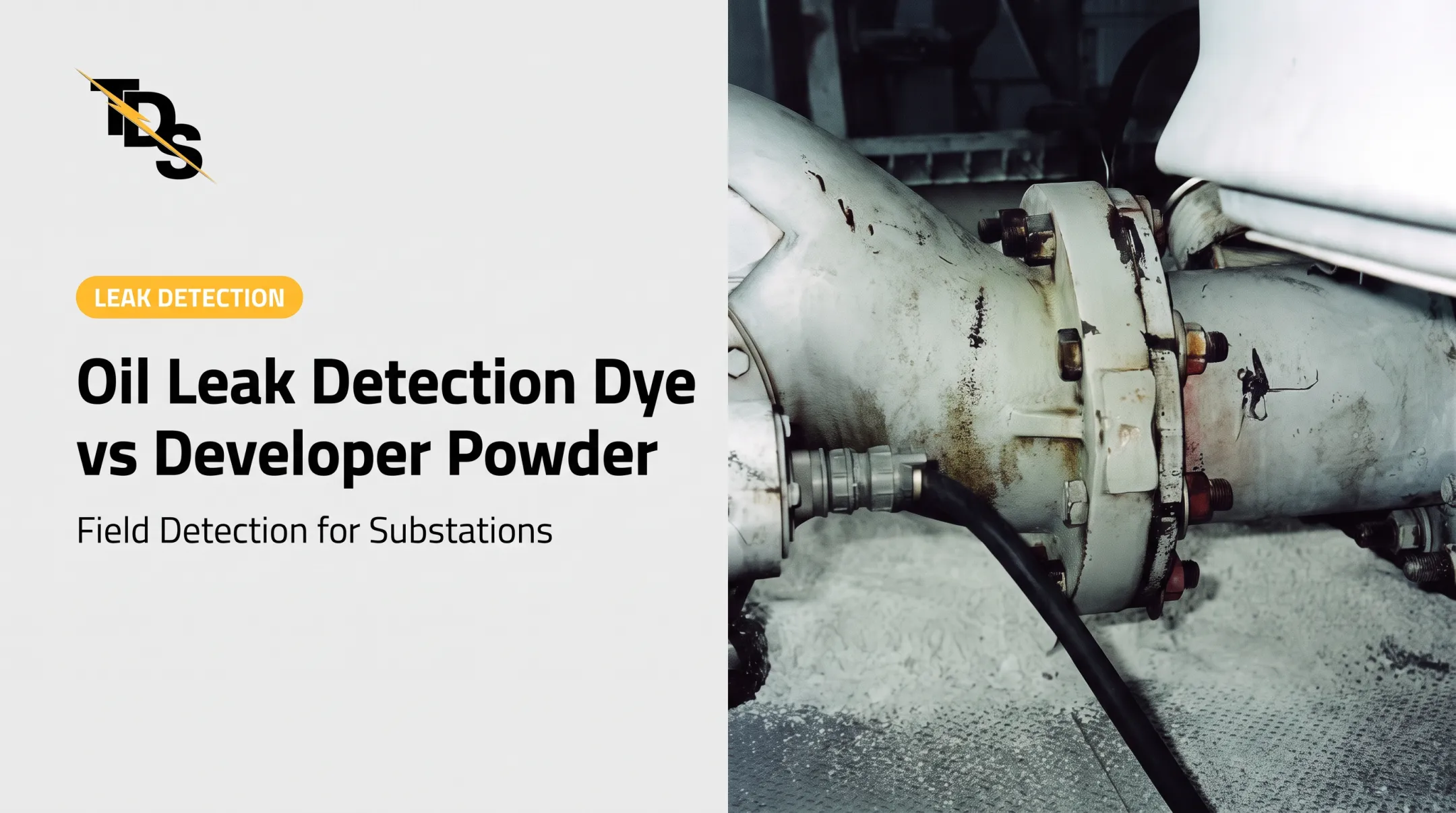
Visual checks, absorbents, and approved cleaning remain a useful layer. TDS's oil leak detector spray is an aerosol powder coating that darkens when oil reaches it, helping crews pinpoint failed gaskets, packing, pinhole leaks, and small weld-seam cracks. Clean the flange first, then spray. It is not a continuous alarm. Use it per the label, SDS, and site safety procedures.
Comparison
| Type | Best for | Location detail | Water discrimination | Reset/reuse | Main limit |
|---|---|---|---|---|---|
| Optical point | Trays, low points | Single point | Product-specific | Often reusable | Local only |
| Oil-selective point | Dry indoor spots | Single point | Higher | Element replaced after oil | Standing water blocks contact |
| Addressable cable | Perimeters, long runs | By section | Product-specific | Varies | Compatibility, routing |
| Float/sump | Collection points | Sump only | Varies | Resets | Late response |
| Spray/manual | Spot investigation | Exact component | N/A | Per application | Not continuous |
How to Choose and Implement an Oil Leak Detection System
- Define the scenario. Slow flange seep, pooled oil in containment, a long cable route, a remote asset, or confirming a suspected leak?
- Check compatibility. Confirm your oil, temperatures, water exposure, dirt, sunlight, rodents, traffic, and electrical clearances. Hazardous-area ratings are product-specific; a cable's rating doesn't carry to its controller.
- Compare performance. Sensitivity, response, location resolution, nuisance-alarm resistance, fault detection, testing needs, and whether multiple conditions report at once.
- Plan integration first. Map equipment and containment, power and communications, alarm ownership, and SCADA/PLC interfaces. NERC CIP-002 applies only if the system is part of a qualifying BES Cyber System, so involve controls and security staff early.
- Estimate lifecycle cost. Include equipment, engineering, installation, containment changes, commissioning, inspections, sensor replacement, and alarm response.

There is no reliable installed-price average for these systems. Request site-specific quotes covering cable length, sensor count, controller, interfaces, and ratings.
What to Do After an Oil Leak Alarm
Triage safely
- Treat the alarm as real.
- Identify the sensor and affected asset.
- Notify the responsible control or maintenance team.
- Follow switching and approach procedures. OSHA 1910.269 sets approach-distance and work-practice requirements for covered electric-power work.
- Send only qualified personnel, following your energized-equipment, PPE, and lockout/tagout rules.
Document what you can
- Alarm time, location, and equipment ID
- Fluid appearance, photos, and apparent source
- Containment status, weather, and water conditions
- Actions taken
Check reporting duties:
- NRC at 1-800-424-8802 for sheens or harmful quantities
- SPCC written report where thresholds apply
- State rules (New York, for example, generally requires a hotline report within two hours)
Keep inspection records with the SPCC Plan for three years.
Detection is not repair
Once the leak is confirmed, repair is a separate step. TDS offers a free equipment survey that identifies the equipment, leak location, proposed repair method, and price.
Its low-pressure approach cures a gasket in place, which can avoid disassembly and reduce downtime. Some repairs can be done with equipment energized when no close approach to energized parts is needed. Not every leak or transformer qualifies.

TDS backs leak-seal repairs with a four-year warranty; confirm current terms before relying on it.
Frequently Asked Questions
What is the average cost of leak detection?
Cost varies by sensor type, protected area, containment, integration, installation, and maintenance. Request a site-specific scope and quote rather than relying on a generic average.
How do you detect an oil leak?
Combine visual inspection, containment and sump checks, oil-selective point or cable sensors, alarm panels, and portable tools. Always follow safe utility procedures around energized equipment.
What are the different types of leak detection systems?
Optical or point sensors suit defined spots; addressable cables cover routes; float or sump systems catch pooled oil; manual and portable methods help pinpoint sources. Each has distinct limits.
Is there an aerosol oil leak detector available?
Yes. TDS sells an oil leak detector spray in boxes of twelve 7-ounce cans. It supports spot investigation, not continuous remote monitoring.
What is the best oil leak detection system for a substation?
It depends on equipment, containment, oil type, conditions, location accuracy, communications, and maintenance plans. Start with a site survey.
Can oil leaks from energized transformers be repaired without taking equipment out of service?
Sometimes, after a qualified assessment and compliance with utility safety procedures. TDS's low-pressure leak sealing can be done in service in suitable cases, but not every leak qualifies.