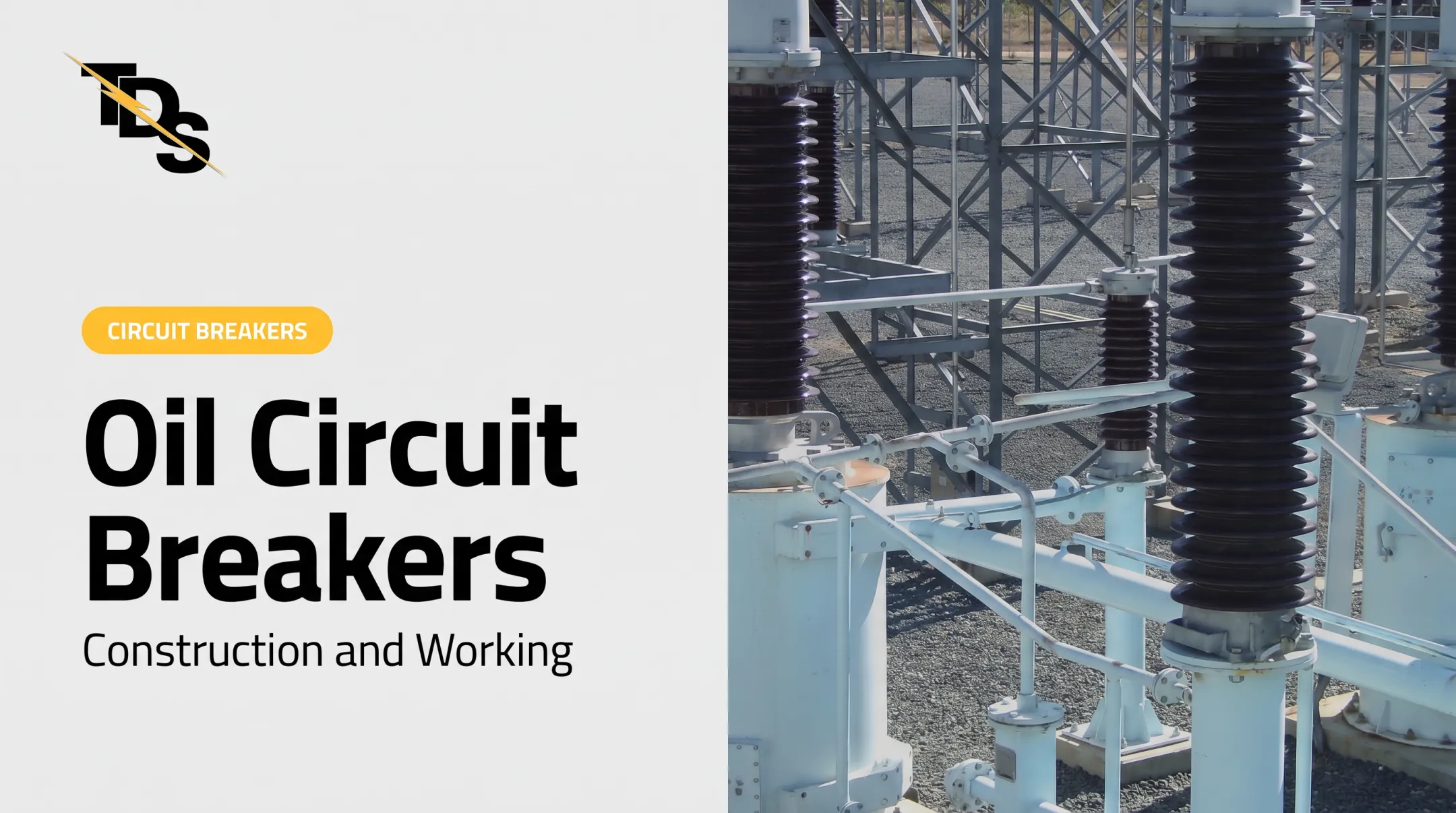

OCBs still matter across US substations, generating plants, and industrial facilities. One Niagara Mohawk filing in New York proposed replacing 87 oil breakers over ten years, most installed between 1948 and 1969. Newer installations often use vacuum or SF6 instead.
This article covers OCB construction, the working sequence, bulk-oil and minimum-oil types, secondary design classes, and how to evaluate a unit in service.
Key Takeaways
- Oil quenches the arc and, in bulk-oil designs, also insulates live parts from grounded ones.
- Bulk-oil (BOCB) and minimum-oil (MOCB) breakers differ mainly in oil quantity and purpose.
- Verify any design label against the nameplate and manufacturer manual.
- Evaluation turns on interrupting duty, oil condition, fire protection, leaks, and maintenance resources.
What Is an Oil Circuit Breaker and Why Is It Important?
An oil circuit breaker (OCB) is a switching and protection device. It opens a power circuit during abnormal conditions and uses insulating oil to control the arc formed as the contacts part.
Oil can do two jobs:
- Quench the arc
- Insulate energized components from grounded parts
Minimum-oil designs lean on solid insulation, such as porcelain, for much of that dielectric duty.
You'll find OCBs in legacy transmission and distribution substations, generating plants, and industrial facilities. Large Westinghouse 345 kV oil-filled units are a familiar example.
When maintenance slips, the consequences add up fast:
- Degraded dielectric strength in the oil
- Contact damage and reduced interruption reliability
- Oil leaks, fire exposure, and unplanned outages
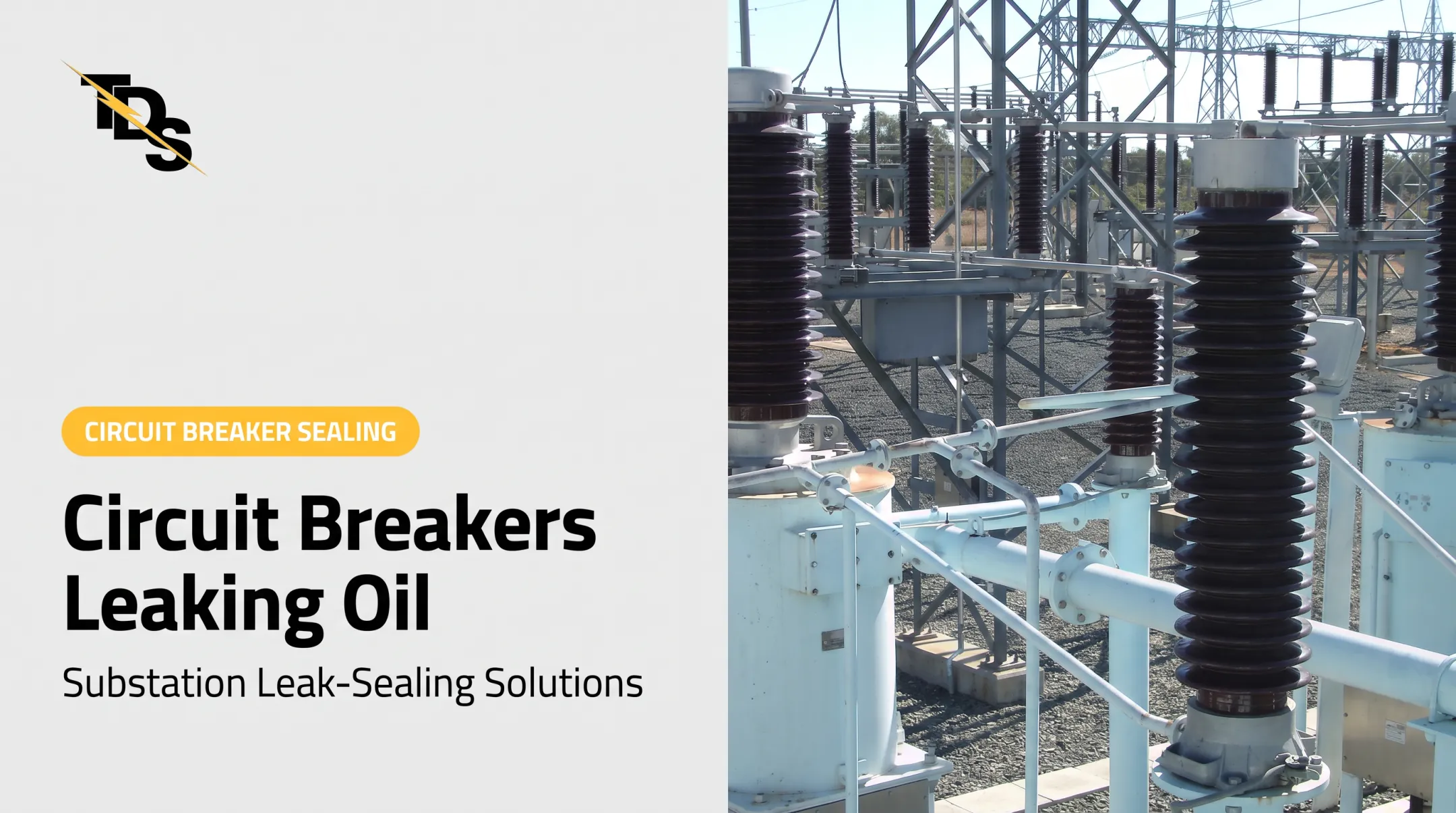
Conventional leak repair usually means taking the breaker out of service and disassembling it. Unchecked leaks also leave utilities exposed during EPA inspections.
Construction and Working Principle of an Oil Circuit Breaker
Main Components
Contacts sit immersed in oil inside a tank. Large high-voltage units may use a separate tank per phase, with porcelain bushings carrying the external connections.
A typical breaker includes:
- Tank or arc chamber and the insulating oil
- Fixed and moving contacts, with contact supports
- Bushings or solid insulation
- Operating rod and mechanism
- Gas-venting or pressure-relief paths
- Arc-control chambers or baffles, where the design has them
Component names vary by manufacturer. Check a labeled diagram against the service manual for the breaker in question.
Bulk Oil vs. Minimum Oil Construction
Bulk-oil breakers immerse much of the live assembly in oil. Minimum-oil breakers concentrate oil around the interruption zone and rely on porcelain or other solid insulation elsewhere.
Interruption Sequence
- A protective relay issues a trip command.
- The contacts separate and an arc forms.
- The arc persists briefly because current keeps flowing through the ionized path between the contacts.
- Arc heat vaporizes nearby oil, creating a gas bubble. ABB reports this gas is almost 80% hydrogen.
- Gas flow inhibits ionization while oil convection cools the arc region.
- At current zero, the arc goes out.
Contact movement, oil flow, and arc-control geometry all shape how well this works.
Dielectric Recovery
After current zero, fresh or less-ionized oil must restore insulation across the gap fast enough to beat the recovering system voltage. If the gap withstand voltage falls below recovery voltage, the arc restrikes and current resumes.

Types of Oil Circuit Breakers
Oil circuit breakers split mainly by oil quantity and function. Bulk oil uses a large volume for both insulation and arc quenching. Minimum oil uses a small volume mainly around the arc, with solid insulation elsewhere.
Bulk Oil Circuit Breaker (BOCB)
A BOCB is tank-based. A large volume of oil surrounds the interruption assembly and insulates energized parts from the grounded enclosure.
Plain-break: Contacts separate directly in oil. Extinction relies on arc lengthening, oil cooling, and gas formation. It is simple but offers limited arc control, and it was the earliest BOCB type.
Arc-control: These add features that direct oil across the arc. Self-blast designs use arc energy to build pressure. Forced-blast designs drive oil by mechanical means. Confirm the mechanism against the manufacturer's documentation.
Single-break vs. double-break: The difference is the number of contact gaps and arcs per pole, which affects arc length, voltage distribution, mechanical complexity, and maintenance.
Strengths and limits:
- Robust legacy construction where oil handles insulation and quenching
- Larger footprint and heavy oil inventory
- Flammability, oil handling, and higher maintenance demands
Minimum Oil Circuit Breaker (MOCB)
An MOCB uses oil mainly in the arc-interruption chamber. Porcelain or another solid system insulates the rest.
Typical construction includes a compact arc chamber, supporting insulators, a moving-contact mechanism, oil passages, vents, and sometimes a piston. ABB notes that in these breakers, arc-generated pressure and convection do the work, and at lower currents piston movement promotes oil flow.
Related configurations:
- Axial and radial venting direct oil and gas movement around the arc in different ways. Suitability depends on the manufacturer's design, not universal voltage or current ranges.
- Oil-impulse designs use a pressure-driven oil jet to assist extinction, though naming varies by manufacturer.
Strengths and limits:
- Less oil, smaller size, lower oil-related fire exposure
- Greater dependence on specialized arc-chamber parts, seals, oil condition, and precise maintenance

Secondary Design Classifications
"Bulk" and "minimum" describe oil quantity and insulation arrangement. Other terms describe arc control and layout.
| Classification | Describes | Typical trade-off |
|---|---|---|
| Plain-break | Direct contact separation in oil | Simple, limited arc control |
| Arc-control | Features that direct oil across the arc | More complex, better control |
| Self-blast / forced-blast | Source of oil pressure | Depends on design |
| Single- / double-break | Gaps per pole | Arc length vs. complexity |
| Axial / radial venting | Oil and gas flow path | Depends on design |
Use the nameplate, drawings, service manuals, interrupting ratings, and applicable standards to identify a specific breaker. Don't rely on the label alone.
How to Choose or Evaluate an Oil Circuit Breaker
Whether you are selecting a breaker for a study, maintaining a unit, repairing it, or replacing it, do not let popularity or a single specification drive the choice.
Electrical Duty
Review system voltage, continuous current, available fault current, interrupting rating, and insulation coordination. IEEE C37.04-2018 defines rating categories including continuous current, short-circuit current, and transient recovery voltage. Pull values from the nameplate, fault study, and manufacturer documents.
Physical and Safety Constraints
- Footprint, tank arrangement, and access
- Oil quantity, containment, and fire protection (see IEEE 979 for substations and NFPA 850 for generating plants)
- Consequences of an oil release; EPA's SPCC rule lists circuit breakers as oil-filled operational equipment
Condition and Maintenance
Review these condition indicators:
- Oil dielectric strength, moisture, acidity, and carbonization
- Contact wear, seals, and bushings
- Operating mechanism and trip timing
- Leak history and inspection records

Active Leaks
If an oil-filled breaker is leaking, confirm the source and condition before choosing among monitoring, in-place repair, outage-based repair, or replacement.
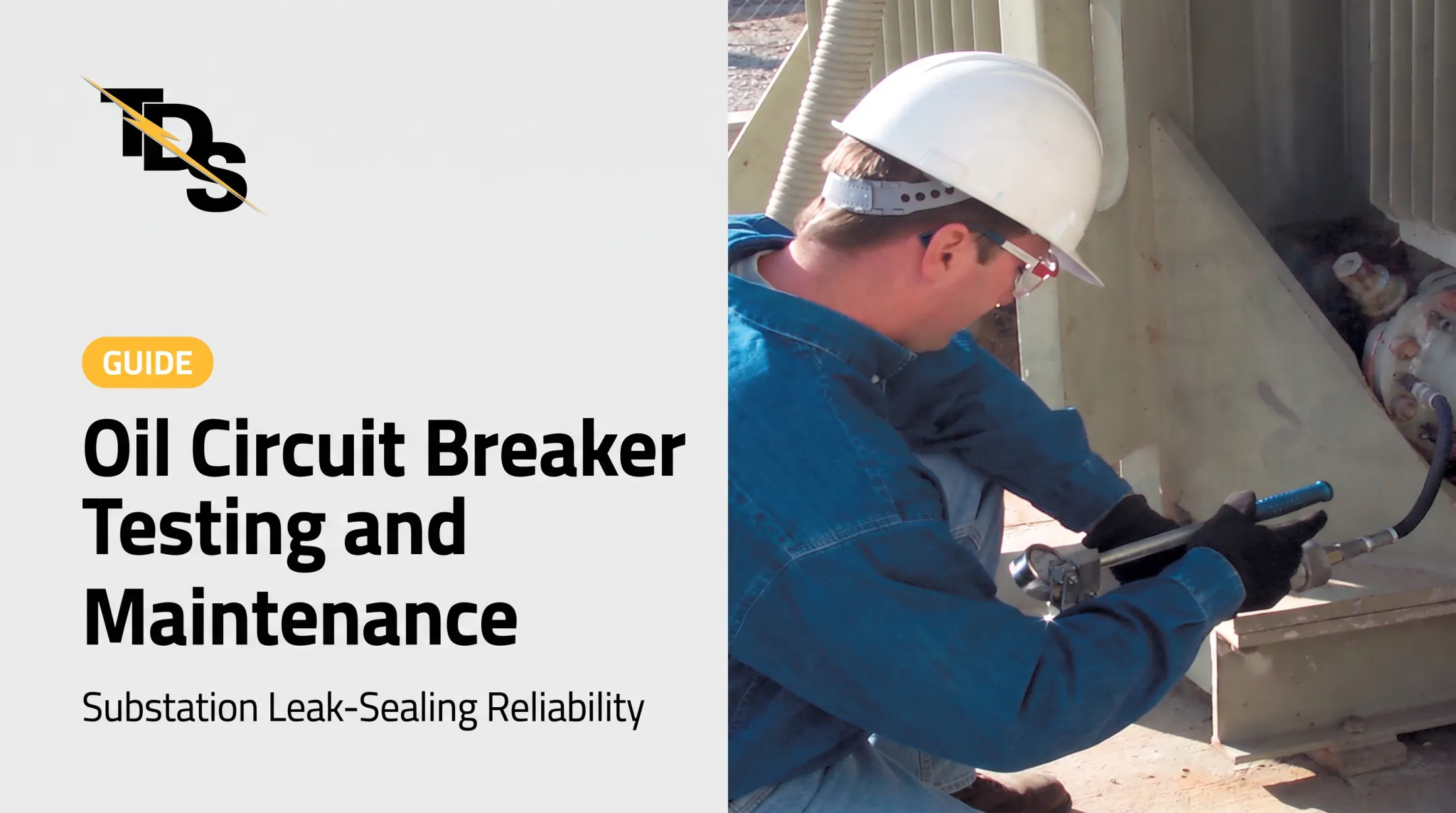
Transmission & Distribution Services (TDS) provides low-pressure leak sealing for oil-filled substation equipment. Typical sources are degraded gaskets at bushing flanges and drain valves.
Bushing and drain-valve leaks can be repaired by drill-and-inject or custom clamps and enclosures with rubber-based sealant. TDS surveys document each leak, repair method, itemized cost, and outage requirements, and can assess whether sealing suits the situation. Not every leak can be repaired while energized.
Common Evaluation Mistakes
- Trusting a bulk-oil or minimum-oil label without confirming construction, arc-control method, and nameplate data
- Ignoring lifecycle costs of oil testing, fire protection, contact replacement, leak response, and outages
- Assuming a breaker is suitable because it has always worked. Have a qualified engineer assess protection performance, safety, regulatory requirements, and the full installation
Conclusion
An OCB uses insulating oil to manage the arc created when contacts open during a fault. Construction varies with oil quantity, insulation arrangement, and arc-control method.
Bulk-oil and minimum-oil breakers differ in space, fire exposure, maintenance, and operation. Secondary classifications explain how each controls the arc.
Reliable operation rests on:
- Verified ratings and sound construction
- Clean, tested oil and steady maintenance
- Prompt leak management
- Decisions based on the actual equipment and system duty
Frequently Asked Questions
What is an oil circuit breaker?
An OCB separates its contacts in insulating oil. The oil cools and quenches the arc and, in some designs, also provides insulation.
What are the uses of oil circuit breakers?
They provide switching and fault protection in legacy substations, transmission and distribution systems, generating facilities, and industrial plants. Current use depends on the equipment and system design.
What is a minimum oil circuit breaker?
An MOCB holds a limited quantity of oil, mainly in the arc chamber. Solid insulation handles the other insulating functions.
What is a bulk oil circuit breaker?
A BOCB uses a large oil volume for both arc quenching and insulation. It is larger, needs more oil handling, and is mostly found in legacy applications.
Which oil is used in oil circuit breakers?
Use the oil the manufacturer specifies, typically a refined mineral insulating oil. ASTM D3487 covers new mineral insulating oil. Verify the grade against the equipment manual and test requirements.
What types of circuit breakers are used in substations?
Common types are oil, vacuum, SF6, and air breakers. The right choice depends on voltage class, interrupting duty, installation age, environmental needs, maintenance strategy, and applicable standards.