
The numbers explain why. DOE's 2024 resilience report and related federal analyses describe multi-year waits for large units. Many substation teams still lack a plan for what happens in the meantime.
This article covers current U.S. lead-time conditions, what drives them, how to weigh repair against replacement, and how to build a contingency plan for localized leaks.
Key Takeaways
- No single "current lead time" exists. Class, rating, design, and testing all shift the schedule.
- Start replacement planning before failure, with an asset register and supplier contact.
- Check whether a localized external leak is repairable before assuming replacement.
- Any repair or energized-work decision needs qualified assessment and utility safety approval.
What Are Current Power Transformer Lead Times in the U.S.?
Benchmarks by transformer class
Lead time is not one clock. It spans specification review, quotation, manufacturing, component procurement, factory testing, transportation, installation, and commissioning. Published figures rarely define their start and end points, so treat them as ranges.
| Equipment | Reported lead time | Source and caveat |
|---|---|---|
| Distribution transformers | 1-2+ years in 2024 (3-6 months in 2019) | DOE, March 2026 transcript; 2024 is the latest data cited |
| Large power transformers | 3-4 years | DOE, March 2026 transcript |
| Large power transformers | 2-4 years order to delivery | NIAC, 2024 |
| Substation and GSU units | 80-210 weeks; 120-week average in 2024 | Wood Mackenzie, cited by NIAC |
| Custom or specialized units | No broad U.S. benchmark published | One factory reported a 5-year wait, an outlier |

None of these are guarantees. Your unit's schedule depends on its own design.
What stretches a schedule
DOE flags bushings and tap changers as potential bottlenecks. Utility specifications also add requirements: voltage and BIL, MVA and cooling, impedance, and unit tests. Insulation, fluid, protection equipment, and utility-specific standards all matter too. Published sources don't quantify the delay each attribute adds, so ask the manufacturer.
Ask for milestones, not a ship date
A quoted ship date hides risk. Request a milestone-based schedule covering design approval, material receipt, core and coil, tank, factory testing, and shipment.
Questions worth asking every supplier:
- Is the production slot confirmed, or only tentative?
- Have long-lead materials and components been secured?
- When is factory acceptance testing scheduled, and can we witness it?
- How will you notify us of schedule changes?
- Which substitutions or approved alternatives would you accept?
DOE reports that accepting a wider range of some components can improve cycle times, so flexibility can pay off.
Why Power Transformer Lead Times Remain Extended
Competing demand
Many buyers want the same factory capacity. DOE cites aging infrastructure, grid resilience, and renewable integration as primary demand drivers. NIAC's 2024 report adds data centers, EV charging, heat pumps, and other large loads, plus replacement of aging units. No reliable U.S. figure isolates storm-replacement demand.
Material and component constraints
- DOE names grain-oriented electrical steel (GOES) and large power transformer manufacturing as the two weakest supply-chain segments.
- Only one U.S. producer makes GOES, and it cannot meet domestic demand for the highest-quality grades at import-comparable prices.
- Bushings and tap changers come from limited suppliers and can become long-lead items.
- Continuously transposed copper wire, insulating materials, and polymers face similar supply constraints.
- Shared test space limits factory throughput, and NIAC reports skilled-labor shortages.
Why capacity grows slowly
Customization keeps new capacity from coming online quickly. GAO notes that nonstandard infrastructure and custom designs complicate spare matching. NIAC says standardization has lagged.
Logistics stretch the timeline further. Large units are heavy and costly to move, and DOE reports international sourcing can lengthen manufacturing lead time. Clearing a rail route for one large unit can take over nine months.

How to Plan for a Transformer Repair or Replacement
Know the fleet you own
NREL estimates 60-80 million U.S. distribution transformers, with roughly 50-55% older than 33 years, depending on the method. NIAC cites an average in-service age of about 38 years for large units. Age alone does not predict failure, but it raises the stakes of waiting.
Build an asset register with these fields:
- Nameplate data, voltage and MVA rating, manufacturer, serial number, age
- Fluid type, operating history, maintenance records, test results
- Known leaks and critical loads
- Spare compatibility and replacement specifications
Rank by likelihood and consequence
Score each unit on both axes. Consequence factors include:
- Generation or transmission importance
- Customer impact and redundancy
- Seasonal loading and environmental exposure
- Access and spare availability
Condition evidence comes from IEEE C57.104 (dissolved gas analysis) and IEEE C57.152 (field diagnostic testing).
Create four planning paths
- Monitor: stable units with minor findings.
- Planned repair: units with repairable issues, scheduled in an outage window.
- Replacement sourcing: units nearing end of life, with quotes and specifications in progress.
- Emergency response: pre-assigned contacts, crews, and authority.
Start procurement early for critical units
For high-consequence units, request preliminary quotes, validate specifications, and ask about reserving capacity, supply agreements, and approved alternate designs. Under NERC TPL-001-5.1, a spare strategy that could leave major transmission equipment unavailable for a year or more requires system-performance analysis.
Weigh risk-reduction options
- Compatible spares and mutual-assistance programs. DOE notes STEP has never been activated, and its trigger is limited to specified presidentially declared emergencies.
- Mobile substations, though their transformers may differ significantly from large power units, per GAO.
- Refurbished or surplus units. No national benchmark exists for availability or delivery time.
Require engineering validation before treating any option as interchangeable.
Set review triggers and decision authority
Re-evaluate when you see:
- Recurring leaks or repeated oil loss
- Worsening diagnostics
- Deteriorating bushings or tap changers
- Abnormal temperatures or protection events
- A change in criticality
Document who decides between repair, replacement, and continued monitoring.
A Practical Transformer Repair-Planning Workflow
- Respond under control. Follow switching, isolation, lockout/tagout, energized-work, environmental, and emergency procedures before anyone inspects or intervenes. OSHA 29 CFR 1910.269 governs this work.
- Confirm the failure mode. Qualified personnel should separate external gasket, flange, valve, radiator, or fitting leaks from internal arcing, winding damage, tank damage, overheating, or contamination. A leak alone doesn't establish an internal fault.
- Gather condition data. Combine visual inspection with DGA, electrical tests, thermography, and bushing and tap-changer checks. Confirm utility, IEEE, NETA (ANSI/NETA MTS), manufacturer, and EPA requirements, including SPCC (40 CFR Part 112) for oil and Subpart DD for SF6.
- Plan around outage and logistics. Cover crew qualifications, permits, access, lifting, fluid or gas recovery, return-to-service testing, protection coordination, and a fallback if the repair fails.
- Compare options. Weigh repair, component replacement, refurbishment, temporary operation, and full replacement on downtime, reliability, recurrence, cost, lead time, warranty, and environmental exposure. Keeping a replacement on order while completing a repair can be a sound hedge.

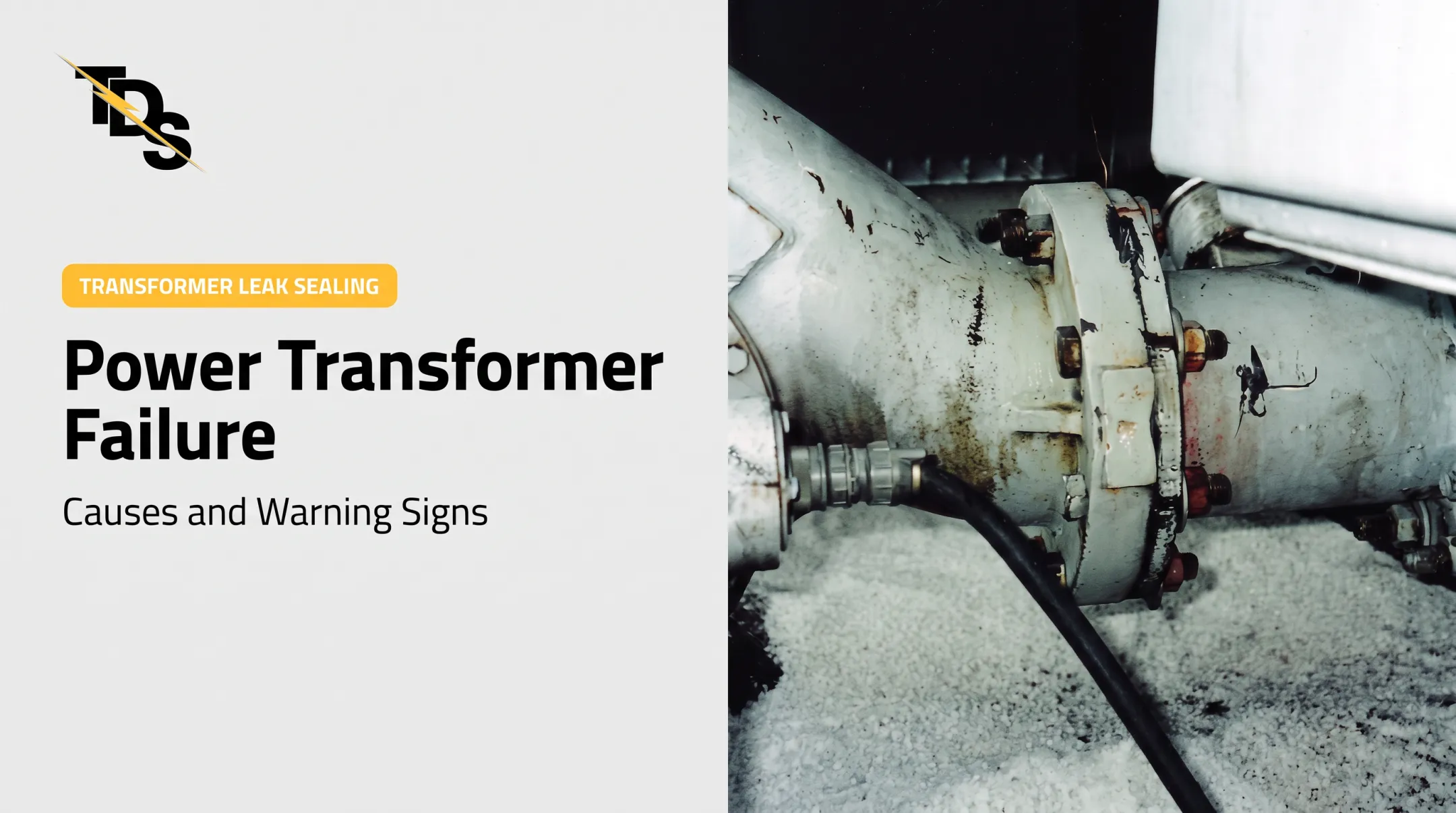
When visual inspection can't pinpoint the source, TDS's oil leak detector spray can isolate active leak paths. In one documented case, oil reappeared at both the flange split line and the stem packing of a 4-bolt flapper valve after the assembly was cleaned and sprayed.
When Leak Sealing Can Reduce Dependence on a Replacement Transformer
When a leak is a candidate
Sealing fits only when the transformer is otherwise serviceable and the leak source is identifiable. It does not fit when evidence points to an internal electrical fault, major tank damage, severe contamination, or end-of-life failure.
EPRI guidance for oil-filled bushings says to repair leaks, but replace the bushing if the leak can't be repaired or the porcelain is cracked or chipped. That guidance is bushing-specific, not a general guarantee.
How TDS approaches it
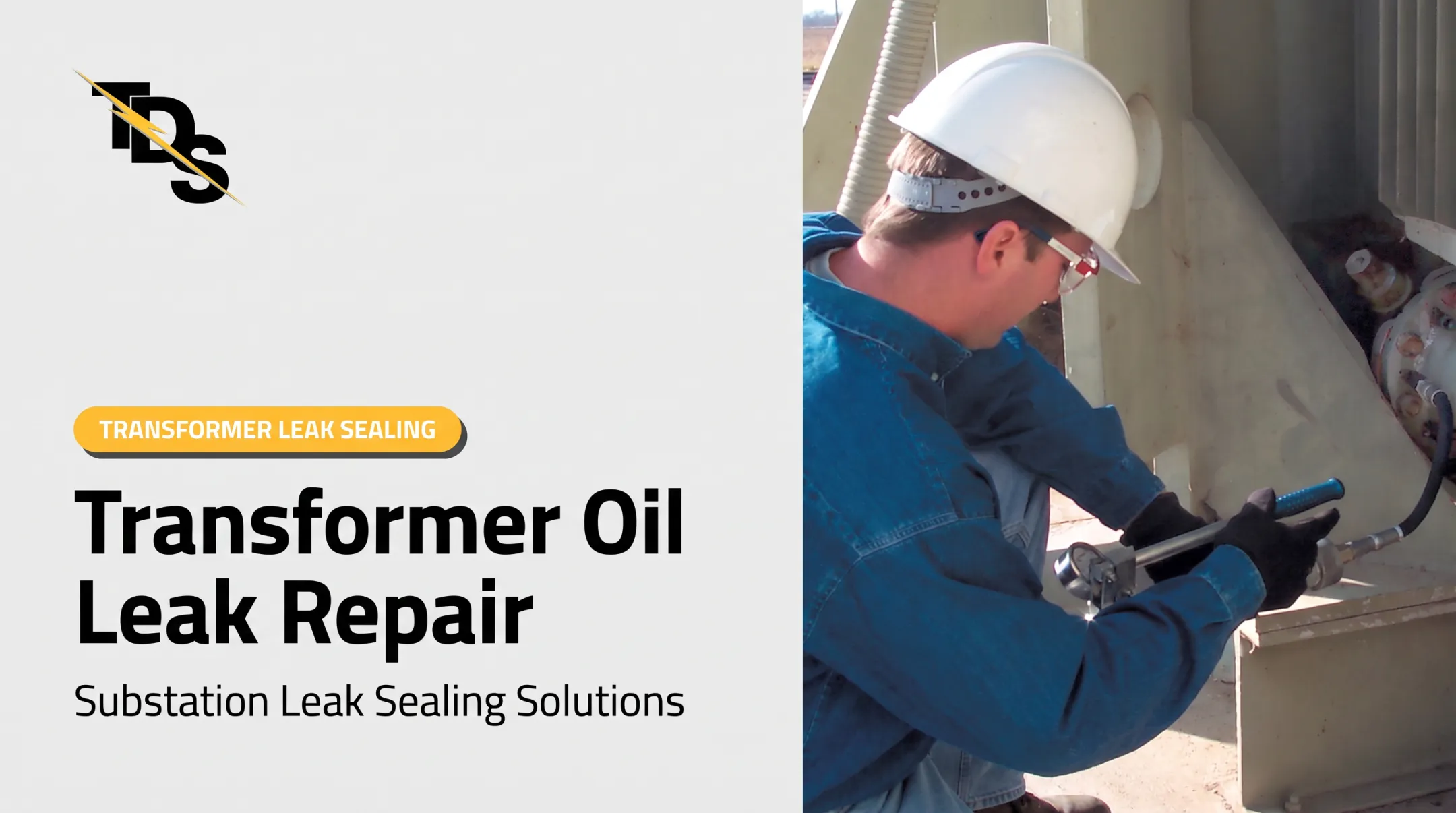
Transmission & Distribution Services (TDS) provides low-pressure leak sealing for oil-filled and SF6-filled substation apparatus, including transformers, circuit breakers, and GIS. TDS states that repairs can often be completed without disassembly, and many can be done with equipment energized and in service when site conditions, utility procedures, and safety requirements allow.
Its published examples:
- A 4-bolt flange can usually be repaired in about 2 hours without draining oil.
- An 8-bolt flange can usually be repaired in about 3 hours.
- Upper leaks may require de-energizing and grounding, depending on proximity to energized bushings and components.
TDS also notes that leak containment can hold a unit steady while equipment is being replaced or until an overhaul is completed. That buys time in a long-lead scenario.
Start with a survey
TDS offers a free equipment survey. The spreadsheet lists the facility, equipment, leak location, proposed method, itemized price, and outage requirements. It serves as the contractual basis for a specific job.
TDS technicians are OSHA certified, and the work carries a four-year leak-seal warranty. Customers don't pay for sample repair work if TDS can't fix the leak. Not every leak or transformer condition qualifies, and the survey is where that gets determined.
Frequently Asked Questions
What are current transformer lead times?
Per DOE's March 2026 transcript (2024 data), distribution units run 1-2+ years and large power units 3-4 years. NIAC cites 2-4 years order to delivery; substation and GSU units range 80-210 weeks. Custom units have no separate benchmark.
Is there a shortage of electrical transformers?
Yes, in effect. Demand from electrification, renewables, data centers, and aging-fleet replacement meets limited capacity. GOES supply, bushings, tap changers, test space, and skilled labor all constrain output.
What is the current capacity of a 200 kVA transformer?
200 kVA is apparent power. Full-load current is kVA x 1000 / V for single-phase, or kVA x 1000 / (√3 x V line-to-line) for three-phase: about 240.6 A at 480 V three-phase, or about 555.1 A at 208 V. Check the nameplate.
How early should you plan for a power transformer replacement?
Well before expected failure, scaled to criticality and condition. Given multi-year lead times for large units, start specifications, budget approval, supplier confirmation, and contingency options for critical assets now.
Can a leaking power transformer be repaired while it remains in service?
Some localized external leaks can be repaired in service under controlled conditions after qualified assessment, utility approval, and review of energized-work, safety, environmental, and equipment-condition requirements. Upper leaks near energized components may require de-energizing.
How do you decide whether to repair or replace a power transformer?
Compare leak location, internal condition, diagnostics, failure consequence, repair reliability, recurrence risk, replacement lead time, outage cost, warranty, and spare availability. An external gasket leak on a healthy unit favors repair; internal fault indicators favor replacement.